Solving for the ShitLOAD
When resistance is high (as I'll make the case it is... everywhere), likability, even transparency, or friendliness are unreliable signals, pointing to economic norms, long in our review mirror.


Before we jump in a few housekeeping notes:
TRUSTFORGE: Small firms and solos can still access our revenue accelerator starting in three weeks, now including sales training I've only offered to our largest clients before. Spots are filling up.
Threshold: I am still accepting people into the waitlist for our live in-person leadership incubator. Learn how to unwind your dependencies on the extractive economic systems around you, and liberate your own leadership capacity. Join the waitlist.
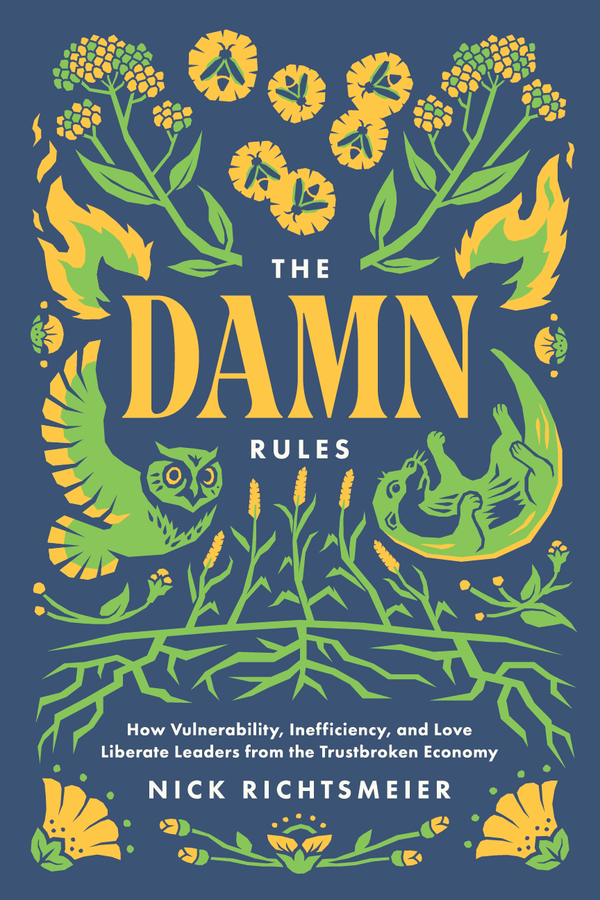
Get the book! Today is a bit of a preview some of what you'll find in The Damn Rules. I wrote this book so that every department head, growth leader, service provider could hand it to their CEO and say, "You know how we've got to do something different in the face of all these trustbroken problems? This is how we should do it." A fieldguide for the expansive economy bubbling underneath. Get a preview or pre-order.
But first! SALES. SHIT. And the regenerative path to trust-made growth:
I was on a call with one of our current clients, working through sales resistance. A LOT of the work right now is in sales resistance. And this should surprise no one. The level of systemic distrust is at all-time highs and every prospect yo are working to reach is sitting underneath what I call the ShitLOAD:
- (L)onely hearts: We are in a loneliness epidemic of dramatic proportions, begun by our addiction to devices and algorithmic distractions and accelerated by the pandemic. The fabric of modern life has made the the daily experience of your buyer the most emotionally isolating and psychologically damaging in human history.
- We used to make friends at work. Now a record high 45% of workers feel isolated in their jobs. (KMPG)
- In 1990 only 3% of Americans reported having no close friends. Today it's 7x that at 1 in 5.
- Harvard found that 65% of American adults experience existential loneliness.
- But the stats don't tell the real story. You do. Cause either you, or the person who work across the hall from you is existentially lonely.
- It's a self-reinforcing problem: John Cacioppo, a University of Chicago reearcher, found that extended periods of loneliness produce hypervigiliance and an obsession with perceived threats.
- (O)verwhelmed minds: Our very structure for knowledge and understanding is self-defeating. We are producing tech-addled, cognitively overloaded minds, now at the speed of AI. The information environment, the pace of decision-making, and the structural demands of modern work exceed human cognitive capacity with catastrophic effects on strategic thinking, creativity, and leadership quality. Leaders can't diagnose the problems and buyers can't think straight because they are training themselves not to. The sycophantic "great idea, let me get to work..." fantasies of Claudic coercion only make this worse.
- Human sustained attention on a single screen has collapsed by 83% in the last two decades, down to 47 seconds. (User Attention Span Research) Imagine how long they looked at your sales deck.
- A Microsoft Work study (ironically, maker of the the diabolical "Teams" app) showed that 52% of modern workers around the globe describe work as "chaotic," engaging in almost 60 chats per day outside of work hours.
- 61% of people question the trustworthiness of online content at least weekly (Human Clarity Institute Digital Trust Report), and yet Americans above the global average, look to their phones over 200 times per day (speakwiseapp.com)
- The delusion that AI "extends" human thinking is broadly disproven. It actually hobbles it. In the short term, AI assistance allows for a brief window of cognitive offloading, followed by a long tail of underperformance on cognitive skills when the AI is not there. It's like training for a marathon in a self-propelled exoskeleton. Practice feels easy, and then you're more exhausted and more hobbled when the chips are down. (Researchers Grace Liu, et al)
- (A)nxious bodies: our bodies, our brain and lymphatic chemistry absorb all of this cognitive and social trauma and turn into threat defense, unhinging us from our prefrontal cortex (PFC) the part of our brain that analyzes, imagines, considers new possibilities, and builds for an unknown future. Anxiety is not a TikTok phenomenon. Just this week a sitting U.S. representative, virtually missing for almost 100 days from his work, said he was away dealing with his own debilitating anxiety. Unheard of, even ten years ago.
- 76% of American workers experience some level of burnout (Mind Share Partners, 2025)
- ScienceDirect confirms that generalized anxiety directly impacts all three core executive functions: cognitive flexibility, impulse control, and working memory.
- HR Dive 2025 survey found 70% of C-suite executives are considering leaving their roles to protect their well-being. These folks are so burdened by their own stress, that they don't even plan on being the room in three years, so why would they consider your three year software contract?
- Systemic (D)istrust: All of this feeds an amygdala-driven trust resistance across industries and regions. As distrust grows, the survival brain activates, peripheral vision narrows, and people get lost in with fear-based triggers, online attention casinos, zero-sum thinking, and tribalism.
- 7 in 10 people globally believe government officials, business leaders, and journalists intentionally mislead them. (Edelman, 2025)
- Five of the world's ten largest economies — the U.S., UK, Germany, Japan, and France — are among the least trusting nations on earth. (Edelman)
- In Edelman's most recent survey, 6/10 respondents reported a high level of "grievance" or belief that businesses, governments and institutions are out to harm them.
- This would be bad enough, except that those acknowledging this belief had a 81% drop in their belief in the ethics of businesses they deal with. Eighty one percent. They simply don't believe you.
The ShitLOAD Is a System
The four conditions are not independent. They compound.
- Loneliness removes the relational buffer that makes anxiety manageable and distrust survivable.
- Overwhelm eliminates the cognitive capacity to solve for loneliness, manage anxiety, or rebuild trust.
- Anxiety activates the survival brain, which closes down curiosity, empathy, and strategic thinking — the exact capacities needed to escape the other three.
- Distrust amplifies all three: it makes loneliness more acute, overwhelm less navigable, and anxiety more chronic.
Together, they produce exactly what my book describes: a leader whose aperture has closed. Who sees only danger. Who cannot pay attention, cannot decenter themselves, cannot see the system for its symptoms, cannot serve a community rather than appease a crowd, cannot see competition as a gift, cannot distribute power, and cannot love strategically.
No way that person, without a transformed context and painstakingly designed experience to lower their defenses, is able to trust you enough to buy.
Going back to my coaching session, the CEO said something interesting:
"We're good in a room. We're warm. People like us. They believe us. I know this is true from the feedback. So we don't seem to have a trust problem."
I asked him the obvious, but unwelcome question: "Do they buy?" (Knowing the answer.) Because if they felt trust, given how little safety they feel everywhere else, then they would. People liking you, or even enjoying you has almost nothing to do with your trustworthiness AND DEFINITELY nothing to do with people's ability to say Yes. In fact, it may be counter-productive.
When resistance is high (as I've made the case it is... everywhere), likability, even transparency, or friendliness are unreliable signals, pointing to economic norms, long in our review mirror.
It's Not Good Enough
The baseline truth that most ventures and sellers of services today don't want to face is that what they've got, the thing they've built, the way they deliver it, what they ask of the prospect in exchange for that delivery... the whole damn thing...
It's not good enough.
It used to be. And what you were doing worked for awhile when the ShitLOAD was not in full effect. When the internet still was open and the flow of information hadn't dried up and we weren't all a sea of alternative facts.
We are all very, very good at justifying our own distrust. You may have read all of that data above and thought - god people need to get a grip. My distrust is reasoned and justified, but theirs... unhinged. That's a version of what the CEO said to me: Normal people should trust us because we're good.
Not good enough.
- The offering isn't focused enough on the needs of real people.
- The experience of buying isn't safe or trust-earning enough.
- The employee culture produces resistance and doubt, which energetically flows to the customer. They can feel the vibe.
- The digital tactics look like participation in a lie factory.
- The messaging sounds like an echo of the sea of sameness that the we've all trained ourselves to not just tune out, but distrust.
If you wanna sell, if you wanna get paid, grow the business, expand to new markets, improve margins, produce outcomes that fulfill on your ethical vision of purposeful growth, you're going to have to be better.
Which "Better"?
Ah, herein lies the rub. Because the first rule of ShitLOAD is that you are under it too. Which means that unless you have already gone to great lengths to improve your mental hygiene, purge your knowledge streams, organize your life around neruologically supportive rhythms, built a team of trusted mirrors and safety-makers for your own well being... you are under the ShitLOAD too.
And the reduced cognitive functioning, closed systems of perception, and resistance to complexity that you feel is just as harmful to your decision capabilities as to the guy you're trying to sell to. You cannot give away what you don't have.
Every leader has to invest in or produce an environment to disentangle the ShitLOAD upon their team and firm, the entanglements and illusions of past successes, and for the brave, the next evolutionary role of the leader.
Can you be a post-ShitLOAD leader? Of course you can. Can you trust? Sure you can. We don't lose trust, we just get out of practice. It's a neurological habit, created by repeatable environments and behaviors. And if we can learn to trust, we can learn to help others to trust again as well.
Nobody likes it when I say that their current work isn't good enough and their belief in their own trustworthiness doesn't matter. It doesn't feel good. But does it feel true? I bet it does. I bet you know that something's wrong in Denmark (who doesn't love a Hamlet reference) and that you, with the weight of loneliness, anxiety, and overwhelm, you feel are somehow in the mix?
This is why when I'm building change environments for my clients, tool structures to free them from the extractive powers of the ShitLOAD to get back to expansive work that invites a broader scale of new clients, new ideas, and new opportunities--I have strict rules about how we design the engagement, handle the meetings, arrange the conversations, make decisions together.
Because we're all having to unlearn one broken system and relearn the rhythms of a new system.
If you want to unlearn the ShitLOAD and relearn how to build capacity for trust (and SALES!) in your venture... if you're willing to see yourself as part of the problem and the solution... and you want the skill of a team that knows how to understand the system of incentives and reinforcments that are keeping you stuck, I'd love to talk with you.
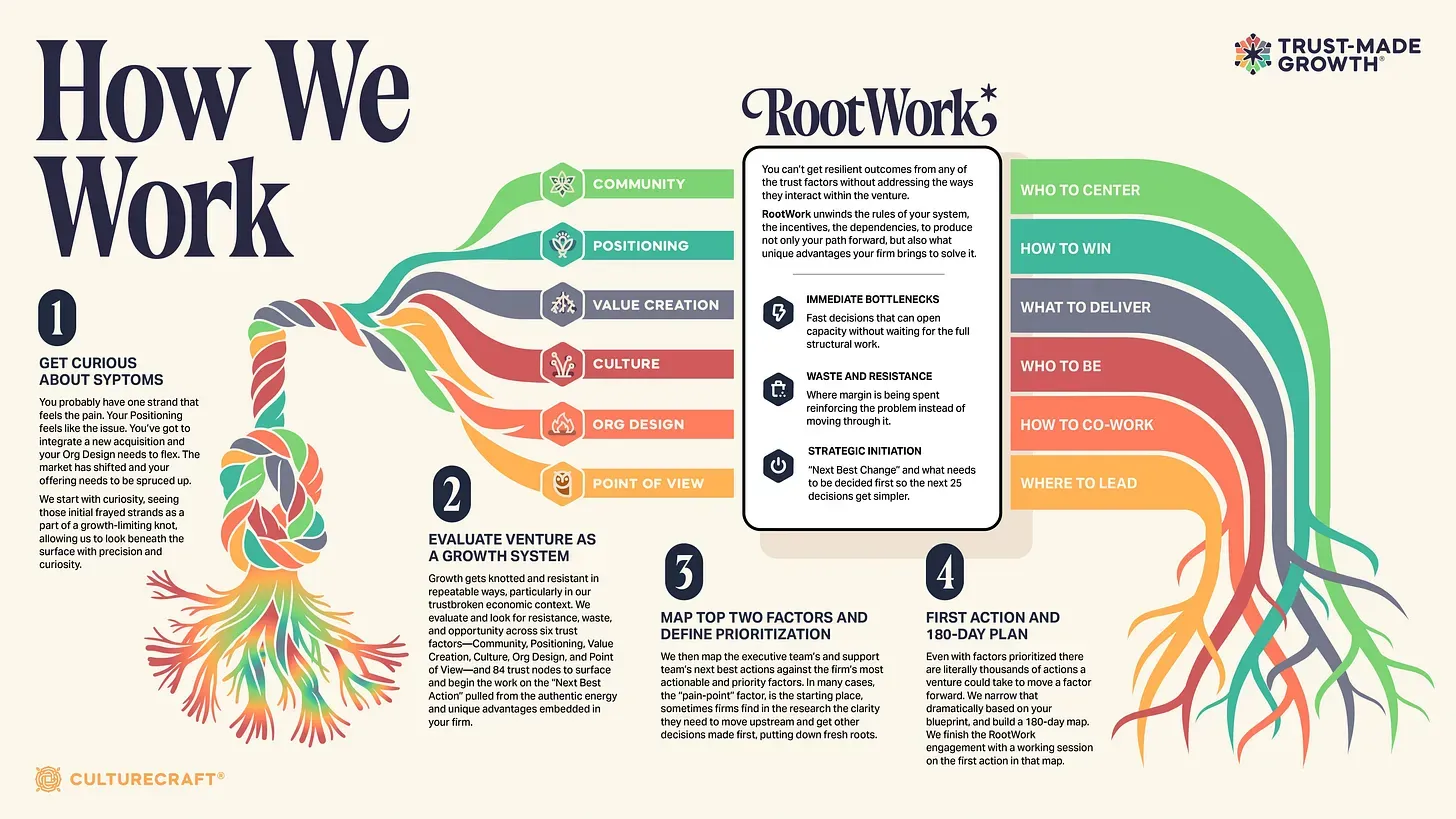
The starting line (customized to each situation) that we use for each leader and team is RootWork. You can learn more about it here or just access the five-minute application which starts the conversation on where your roots are tangled in dead soil, and where we can start composting all that Shit to produce new growth.