The Casino Nobody Warned You About: The latest AI chaos and fear-selling is back in vogue
A sh*tstorm of news from the AI front has settled in, raising the stakes on the fate of the universe, curing cancer, CEO avatars, and AI models so fearsome they dare not be mentioned. What's a CEO to do?

A shitstorm of news from the AI front has settled in the past couple of weeks, raising the stakes on the fate of the universe, curing cancer, CEO avatars, and AI models so fearsome they dare not be mentioned, except by the Chairman of the Federal Reserve. And at the end of it all: what's a CEO to do? All on this week's pod.
Mythos and AI Zuck and OpenAI TV, oh my
It's funny how the zeitgiest-iness of it all has started to soften into a dull hum, like how the crushing waves of the ocean eventually lull you to sleep. We've been in AI or die for almost two years now. We've lived through the rise and relative waning of the "AI Nevers." (though they still do exist.) And in the real world, my Founders and CEOs, the ones I hear from every day, are in the tightening crevice between potential nirvana and actual chaos. Apparently only a spin of the roulette of some future AGI can tell them which it will be.
Anthropic using the so-called dangers of their Mythos release to scare up PR doesn't solve business problems. Zuck using the PR of how much his employees would rather talk to his high-res avatar doesn't solve business problems. And yet they are at the trillion dollar epicenter of economic decision making.
Leaving the hard decisions with very limited resources.
Getting people a pile of AI licenses is easy. Building an organization that operationalizes what matters, protects its data and IP, ensures data quality going out the door while the head of client service is writing every email in ChatGPT... that's another story all together.
There is no substance to the AI or die threat. But there is substance to the application of a new wave of innovation and a system wide labor disruption that goes with it. The kind of substance that I've been interrogating for the last two years, and this week I got to go one layer deeper.
Why is it this way?
I don't have questions about why we got the rise of LLMs and their inherent promises of labor-market transforming technology. The underlying technology that allows for large data set retrieval and chat bots that sound relatively like humans has been around for some time, what it took was the volume of capital and the laser attention of Silicon Valley to decide that of all the technological mountains they were going to drag the planet up, this was the one. Curing cancer be damned (Yes, I know Claude is supposed to cure cancer once he becomes sentient, bear with me, I'm not holding my breath.)
I'm not opposed to the massive progress in compute power and some of the nifty things it can solve for. (I'd rather it not piss in our drinking water or steal every known piece of creative IP on its way up the value ladder, but I digress, we are where we are.)
What I have wondered for more than the last year though is--of all the "AI" we could have gotten. Why did we get this one? The one delivered with such heavy handed threats? The one whose creators seem hell bent on havoc and not service? The one that when applied as advertised creates almost as many problems as it solves?
My business—growth by way of integrity and trust, free from the tendrils of extraction—is fundamentally about risk management. How does a venture take on its next era of expansion, without:
- Burning cash flow on tactics and good ideas that produce no revenue
- Putting credibility through the shredder by chasing fads and mass content
- Confusing past clients with a model for future clients
- Basically blowing up the company you've got while you do the soul-making work of discovering the company you've got to make next.
This is hard enough work without a global overlay of "use our bot and nothing else will matter." Our CEOs, the ones that use our trust-made systems, are too wily for this kind of coercion. Our trained strategists, the ones who are leveraging Trust-Made methodology in their offerings, would never. The extremist position of the AI propagandists is an anchor, though. It has moved reality of what success looks like and how you're supposed to get there. And almost no business should be floating around this economy without a laser eye on tech-enabled upgrades in their competitive space.
And yet, almost the worst thing you could do is buy a bunch of enterprise out of the box AI and let it run free on your org. No matter how you feel about the piss in the water or the scraped IP it took to get us here.
But what DO you do? Well, I've been waiting since last year to get on the calendar with the guy I wanted to ask just that question.
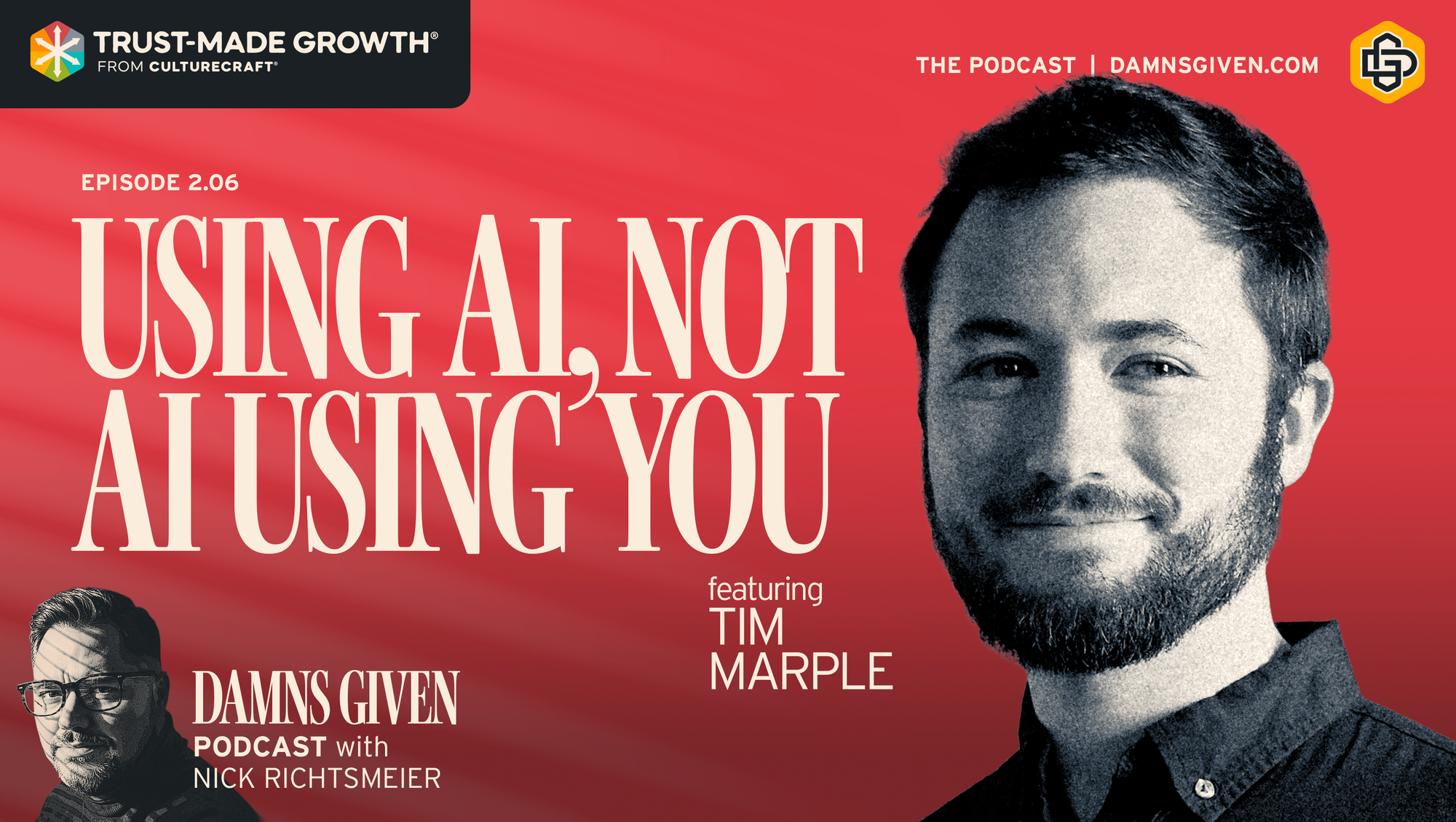
Enter Tim Marple, PhD, AI Risk and Economic Disruption Scientist
Tim had a run at Google. Then another in the now defunct Risk team at OpenAI. And before some of the most heavily funded stock options in the world could vest he said, "Yeah, that's a no for me dog." And walked away.

Now he's the co-leader of a non-profit research lab, one that understands the implicit assumption that ventures will be using AI to build their companies for the foreseeable future. But...which AI? and with what controls and what effects? Most importantly – How to do it and not do the two things the AI guys most want you to do:
- Make your business wholesale dependent on AI credits that they are gonna double and triple the price of in the coming years, and
- Turn a blind eye to the surveillance, data scraping, and breakage of your privacy covenants it'll take to give you the magic you want.
I've interviewed a lot of smart people in the last year, and there are more coming on the pod, but I'll tell you this, Tim blew me away.
I think he will you too. This one's worth a listen or two or three. Every paragraph has something to take away.
Damns Given Episode 2.06 - Spotify | Apple | YouTube or wherever you get your pods.