The meteoric rise of DIY in B2B: Or what to do when the client is the competition
Sales is where we negotiate value. You have to make the case for your value not as a replacement of the in-house team, but as a compliment. Which will require two skills: The Art of Co-Creation, and Framing the Proximity Problem.


Newsletter Edition 157
I had a conversation with the leader of a nine-figure firm some time back that put some things into perspective. Obviously one data point doesn't make a trend, but it confirmed in stark terms some things I'd been seeing in the hints and nudges arena, pressing me to unavoidable conclusions.
Without going into detail, I saw how so many venture leaders have gone to great lengths to not know what's going on out there. Being a CEO feeds, in most cases, on optimism, and it's not hard for that that to shift ever so corrosively into hope-timism. The stunning belief that everything's probably fine or will be combined with the resources to surround myself with voices and structures that allow me to believe it.
I understand. It's VERY hard to run an organization and grow it with a sober view of what's happening in our technocratic world, powered by addiction machines and economic extraction that nearly every business is structurally dependent on. It's the kind of thing that used to drive people to drink. Now we just scroll on Instagram.
So much do I understand this, that I'm dedicating the last episode this Season of Damns Given (the Podcast) releasing this week to the unplanned lessons I've learned about these uncommon times in the last six months. The ones I'd thought I'd learned before, but lucky me got to go back and do the re-test. You'll definitely want to be subscribed and listen (Apple | Spotify | YouTube) to make sure it ends up in your pocket.
But scale and the financial blinders that come with it, are not the only viable ways to close our eyes to the forces at work keeping good businesses run by purposeful founders trying to expand opportunities for themselves and others entrapped.
Finger crossing and fundamentally being dishonest with themselves (a trait I've lived through in myself more times than I care to consider). You, like me, are being obsessively incentivized to ignore how trustbroken our economy has become and the massive pressure that presents for your venture and for leadership.
I had a coaching session with some of our strategists last week that was met, in the beginning with blank stares - why are we doing this exercise? Where we led them to much more vulnerable places about who they were serving and why and what the had to actually do with their honesty, their passion, and their willingness to challenge their beliefs about themselves. Economic therapy is a real thing.
And increasingly, it's required.
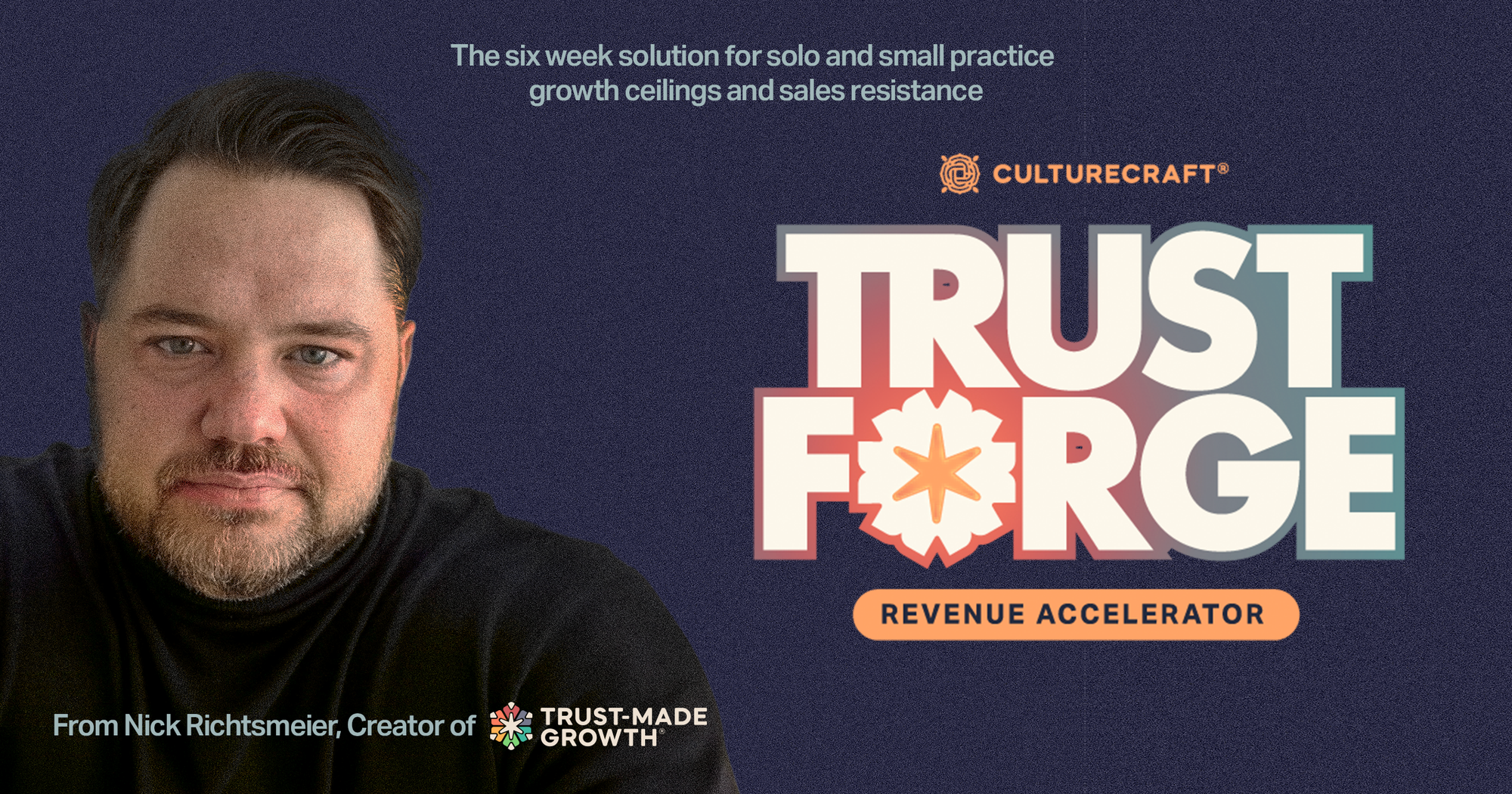
If you haven't yet, I want you to strongly consider doing some economic therapy yourself. Stepping into what I call a crucible of effort to reframe your offer, the way its sold, the skills you bring to that selling, so that you can actually find the success you imagined and perhaps were once more familiar with in these trustbroken times. We call it TrustForge, not just because the work will produce greater trust between you and your prospects and customers, but because it will pull you into deeper trust with yourself. Your intuition. Your skills. Your drive to build. It is a reclaiming of your place in the market. Registration closes next week. We are only taking a maximum of 15 participants. You guys know me and know I don't say this - If any of the things above resonate for you, its worth 10x the investment you'll make.

"TrustForge gave us better sales conversations, established our expertise much earlier, and cut our closing time in half. I can't recommend enough."
Now onto the main event: Fighting the customer for their own good.
In my book The Damn Rules, which finally dear god releases on September 15 (can't come soon enough) I take you though the seven rules that will determine your access to the expansive economy bubbling up under the iron fist of the extractive one ruling headlines and markets. I am convinced that for 99.9% your ability to play by the rules of expansion, will determine your ability to determine your own economic future.
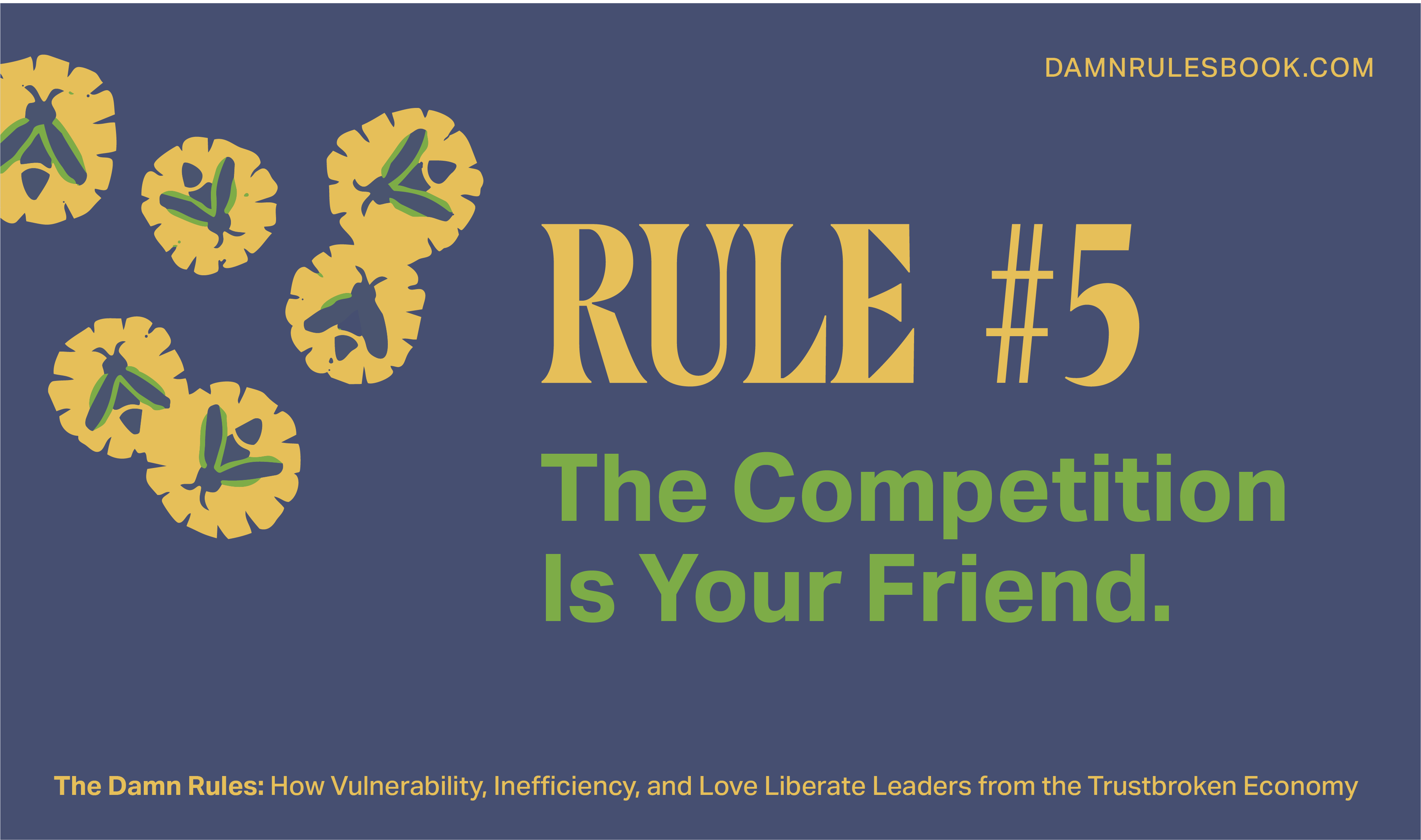
Rule #5 in The Damn Rules is: The Competition is Your Friend. Don't miss the blatant anti-monopoly, anti-blue ocean, anti-category of one rhetoric here. Extractors play and win by aggressive ego, collapsing scarcity, and false premises. All of which are richly seen in the above. But more than drawing you out of these deceptive games offered in rich supply, Rule #5 grounds you in the actual lived experience of your customer. Customer's don't buy in the year of our lord 2026 because you are the only option or because no one can do what you do. They have endless options.
The mind, when it's not making up stories to explain the wild experience of conscious life, is creating taxonomies. Breaking things down into categories. When presented with a new choice, it is inevitably asking, "What kind of thing is this?" "What it is like?" "To what group of other things does it belong?" And, for those of us that sell things (which is everyone), "What else might I choose instead of this thing?"
These category defining choices that every buying brain is making all the time, produce arenas of competition. Where for Problem X, Buyer A's brain is willing to consider options 1, 2, or 3 because from their vantage point, they all constitute similar ways of getting at central problem.
The hard thing to learn (because the extractive game around us really wants us not to learn it and because the protective force of our ego is constantly trying to make us feel more special than we really are) is that these competitive sets, these categories, are a gift. Once you allow them to be defined not be the NASDAQ or by Gartner, but by the customer. They are telling you what your set of competitors are. And if you are a student of this, then the competitors start doing two really important jobs:
- They train the customer how to frame the problem: Even our worst competitors are helping to define the problem for the prospect. We may not totally agree with their framing, but that gives us something riff off of. The annuity salesmen says the fundamental problem of retirement is guaranteed income. The fee-based investment advisor, counters and says, no, that's playing to your fears. The problem is decision-making and financial optionality. Love them or hate them Fisher Investments has become one of the fastest growing and largest by depending on its competition to misframe the problem. What a gift. If no one sold annuities, there would be no Fisher Investments as we know them. (Again, there are other issues with Fisher, for the sake of this example, they're make the point.)
- They elevate the risks of doing nothing: The ultimate enemy of commerce is indecision. It's one of the reasons why beyond a handful of government-enabled technocratic monopolies and their supply chains, that the economy is in such a challenged place. Lowest level of employment participation in half a century. Because the chaos of our trustbroken state has elevated indecision to look like wisdom. "We'll just wait til things settle down" has been the refrain for just short of a decade. And the decade before that was overrun with indecision due to a global financial crisis. So your buyer, particularly if they are younger than 50, is masterful at indecision. They've been trained to practice it for two decades. (As have, likely you and I, which is why its so damn hard to do what needs to be done... another piece of the Damns Given pod episode dropping this week.)
We love it when our prospects realize the opportunity cost of doing nothing. We love it when they feel it. When they understand that Problem X is real, multifaceted and deeply impatient. It will corrode at the fastest pace it possibly can until you do something to stop it. We hate Problem X. Something must be done. And you, who sell a best-in-class solution to Problem X, do you know who is doing a lot of free labor for you helping your customer understand the risks of Problem X and the opportunity in solving it? Your competition. They're such lovely people. Thank God they're here.
Unfortunately, you probably have a competition problem. Because increasingly, due to shrinking margins, efficiency cults, and the false promises of AI transformations, many of your good customers are considering the question, "Can't we just do this ourselves?" They agree the problem exists. They even accept the risks and the need to act. But moreso these days, you aren't competing with alternative vendors. You're competing against the internal team's capacity and ability. Sometimes the exact team that would be your partners should you be brought in to help. Messy messy business.
- You're a software provider that improves development outcomes.
- You're a growth strategist or agency that improves revenue velocity.
- You're a team and culture specialist that builds systems for internal communications and alignment.
- You're a content strategy house that aligns the organization around core messaging for internal and external use.
In all of these cases and more, your entire sales motion (if it was well-built on past principles) depends on contrasting with the pros and cons of what the client assumes to be their other options. "They do this" vs "We do that" or even if you've bought the blue ocean fallacy, you are saying some version of "they do that to solve for that other thing" vs "we solve for this completely more important thing that nobody else has realized" (a bold claim dripping in the usual marketer-induced delusions.)
Now, the person whose ability to solve the problem you used to use your sales process to question, is sitting right across from you deciding if they're willing to buy. Whoops. This is the chaotic rise of DIY as a core B2B business strategy and it's not going away.
Sales is where we negotiate value. You have to make the case for your value not as a replacement of the in-house team, but as a compliment. Which will require two skills (both of which I'm teaching in the TrustForge workshop) - The Art of Co-creation, and Framing the Proximity Problem.
Framing the Proximity Problem - "Why the fuck are there so many dirty dishes?"
The closer we get to something, the harder it is to see it. This is just a fundamental of human experience. Hand-wavers might say, "Yeah but what about microscopes? Zooming is important." Sure. If the thing we are examining is so infinitesimally small, then zooming in matters. In that case, we aren't close enough. But most of the time, we struggle as humans to be close enough to see what's actually there (our eyesight is limited) and far enough a way to recognize the system as operative.

Let me explain what I mean. It's summer in teenage boy land at my house which means we are overrun by many things, but specifically dirty dishes. They are everywhere all the time. When I walk into the kitchen and see the piles of oatmeal bowls, shake cups, empty protein shake cartons, when all I can see is the trash pile and my own rage, it's very easy to scream, "Why the fuck are there so many dirty dishes? Who's chore is dishes today?"
But what if I step back. I find out it's Evan's day to do dishes and he did them already this morning. Even hand washed the ones in the sink. But then Cole decided to make homemade brownies and the dishwasher was running and full. And Grant was building snack packs for his soccer practices. And I – whoops, I'm complicit here too - made eggs for breakfast and didn't wash the pan because the dishwasher was running and everything was piled up. This is not an Evan problem. This is not even an irresponsible kids problem exactly.
Zoom out a little farther, and Grant did the dishes yesterday. And Cole the day before that. Turns out, upon further review, that we, in a house of five pseudo-adults each with diverse food proclivities and a preference to cook their own meals, produce an ungodly amount of dishes. Too many for our once fruitful, one kid, one round of dishes per day system.
I'm gonna have to break the system I made. The one that served me so well for so long. That's the real problem. And I could only see it, but stepping back. Am I skilled enough to solve a problem I am actively creating? Now there's an interesting question. One that a few hours fucking around with Claude will get you nowhere in solving. And one that your client likely resonates with. They don't have an intelligence problem, or even an awareness or skill problem. They have a proximity problem, and that's VERY difficult to solve from the inside.
The Art of Co-Creation
Businesses spend $6 in services for every $1 they spend in software. And yet, when I'm talking to software companies it sends dramatic chills down their spine to talk about their ability to deliver services. Transformation services. Consulting services. But as Julien Bek of Sequoia Capital said last week, the next $1T company will be a services company.
And I will take it one step further, they will do it by the power of co-creation.
Our old model of services is "we make a thing over here and throw it over the wall to you and then you use it or don't and we get paid." That model is toast. It was vocierferous in the agency world, in content, in development... The ironic thing is that it was the early stages of AI that started to break the monopoly here. AI companies (the old data management kind, not the talking suicide bot kind) like ones I've worked with had unique capabilities and tools, strategic understanding, and working experience in complex environments that they brought to their enterprise clients, buried on old systems and proximity problems.
Then the AI teams and the internal teams, both of which had unique knowledge the other needed, locked armed, used their shared understandings to co-create something better than any one could have done alone. Transforming the future of the business. Our past client, Kingland, was and is masterful at this kind of work with its large scale financial services clientele.
Their work would be impossible without services, not just software and technical know how. And they had to build something together with the client, not for the client. pulling them onto the same side of the table as the internal teams.
It takes intention and care to move an existing offer based on old-school B2B services to an offer that is built in co-creation. You usually can't have it be you out-of-the-gate offer. The trust just isn't there, no matter how likable you are. (Likability and trust are often at cross-purposes with each other, but that's another newsletter for another day).
Regardless of how you get there, these pivots are required in a world where more and more your buyer is also your competitor. And the person writing the check for your services is actively contemplating how to do it themselves. You don't win by proving them wrong. You win by proving them right. They should do it themselves. Build that internal capability. And they should do it with your help.
You should build an offer and an engine for co-creation with your clients. And a way to sell it that works for them and you, even with trust in sales at historic lows. And I would love to help you get there.
Join us for TrustForge before it closes if any of this resonates for you.