This one's not for everyone
Not knowing what to do will be a terminal condition for most of us and for most of our ventures. There's just simply too much of the past slipping under our feet to reconstitute anything recognizable as "normal" in the next twenty years. But the lesson is obvious: Lead anyway.

I'm going to start in a way I've never done before, after hundreds of editions of this newsletter. I'm going to start with asking for permission.
Today's topic is one that has been brewing in me for awhile and is perhaps my most honest analysis of what I am seeing both in the business climate, in the economic trends, and most intimately—in leader's experiences on the ground.
It's going to get personal. And so I want to ask your permission to move forward. Like a movie podcast that says, "now we're in the spoiler section of the pod, so if you don't want to get spoiled, jump off." Except in this case it's, "I only want to have the conversation with you if I have permission to say the honest thing." And if I don't have that permission with you, and many of you I probably don't, you should jump off right now. Now harm. No foul. Just an agreement that we aren't ready to have this conversation together.
You can join the conversation about modeling revenue that dropped last week (reply to this email to get the full 45-min training), or the eight-minute accelerator episode just dropped today - My One Rule about Culture. Bangers all. And we'll see you back here in the newsletter at a different time.
But if I have your permission to be honest about what I'm seeing at a level that I haven't before, then let's talk about the one place all of this uncertainty goes. We're going to go to some dark places that I don't have enough humor chops to make readily palatable, but we'll come out the other side with a bright shining hope for the right people. But as with anything good, we've going to have to go through to get there.
Start with the most logical assumption
To go down this road with me, you have to start with the most logical assumption there is: no one knows what's going on. Not really. And certainly no one knows what to do about it. Not in any tactically systemic sense. Bad news for the Substack people (of which I am one) who are drawing maps of the territory like mad fiends. Bad news for the LinkedIn people and their promises of how their little quippy system is the solution for those scrounging for the last flavorless scraps of the illusion that was the attention economy.
Because we are (and have been for sometime) entering an economic, technological, and socio-economic copse never seen before in human time, with a convergence of variables not even imaginable as early as fifteen years ago (tell 2011 you that Trump is president, the western hegemony is over, the U.S. is now trading its allies for economic access to China, coding is the worst path to a profession, and the internet has more bot content than human content and see if 2011 you believes you.) — because even that list is just a group of symptoms of the underlying interregna, everyone who says they know what you should be doing tactically is lying. Mostly to themselves. And who could blame them. It's the economically safe thing to do.
One of the most fundamental chaos elements of the AI explosion is its bright shining light on the "here's what to do now" (HWTDN) complex. We used to run an economy, get millions of people enough money to pay their mortgages and buy their groceries in a giant circle of "here's what to do now" purchases. The HWTDN finance guy buys HWTDN services from the HWTDN marketing guy who buys his HWTDN from the business growth woman who buys her HWTDN services from the personal branding lady who buys her HWTDN services from the personal wellness guru who buys her HWTDN stuff from the mindfulness coach who buys her HWTDN stuff from the finance guy... and the circle continues.
Until all of them can get their HWTDN stuff for all but from form "Hey, Margo, what do want to work on today?" asterisk bot sitting on the top layer of every device, web window, and social media page.
It is both convenient and terrifying that everyone can get their HWTDN mass market ideas from a free machine. All while, at the same time as everyone else – in the closet of their honesty – can say, "It's fine. I never really knew what to do anyway."
The generational permanence of uncertainty
Not knowing what to do will be a terminal condition for most of us and for most of our ventures. There's just simply too much of the past slipping under our feet to reconstitute anything recognizable as "normal" in the next twenty years. I suspect sometime at the end of my career, or shortly thereafter, the rearview mirror will start to defog. "Oh that's what that was, and this is what the new normal is." But that is a long-time coming. And the smart money is on refusing to wait for that day.
As I explain in greater detail in my forthcoming book, we are at the end of five concurrent eras, ending five systemic norms all at the same time. Bringing us the force of five interregna (ending of ruling eras) all at the same time, each one a collapsing system with no clear replacement yet in sight.
The Marketplace is the first. The digital inbound funnel — content marketing, SEO, social media leads, all through a predictive network of digital links and trigger points... gone. AI and platform decay killed it, and nobody has figured out what comes next. Google I/O last week made clear. The web as anything other than content with an agentic overly is going to be thing of the past.
The Commons is the second. The open web is closing. Platforms have stopped sending people outward via hyperlinks, bots now outnumber humans in web traffic, and Google is literally patenting the ability to replace your website with its own AI version. The mass reduction in traffic movement has turned most media operations into content factories, no longer trafficking in ideas, just clicks. The digital commons destroyed monoculture of print and televised media, and now its destroying itself.
The Politic is third. Neoliberalism — the seventy-year operating system that set the state as the guardian for markets, and shareholder economic growth as determinative of our collective good is over. Trumpism drove the final nail but offers no coherent replacement, leaving the relationship between government and economy in freefall.
The Organization of Power is fourth. The Westphalian Order — the 400-year-old agreement that land equals power and nation-states are the highest form of human organization — is collapsing. The internet dissolved physical boundaries, and authoritarian regimes have rushed into the vacuum. In the mean time, pseudo nation states in the form of global technology megacorps, accountable to no one take over land, space, and air.
How We Know What We Know is fifth and deepest. The print era — which for 600 years gave humans a shared foundation for what counts as true — is ending. Generative AI has made written words as likely to be hallucination as fact. Words are now dissociative from meaning and meaning is dissociative from experience, no longer able to be traced back to a human who as lived a life to justify the worthiness of those words. We have no replacement epistemology yet.
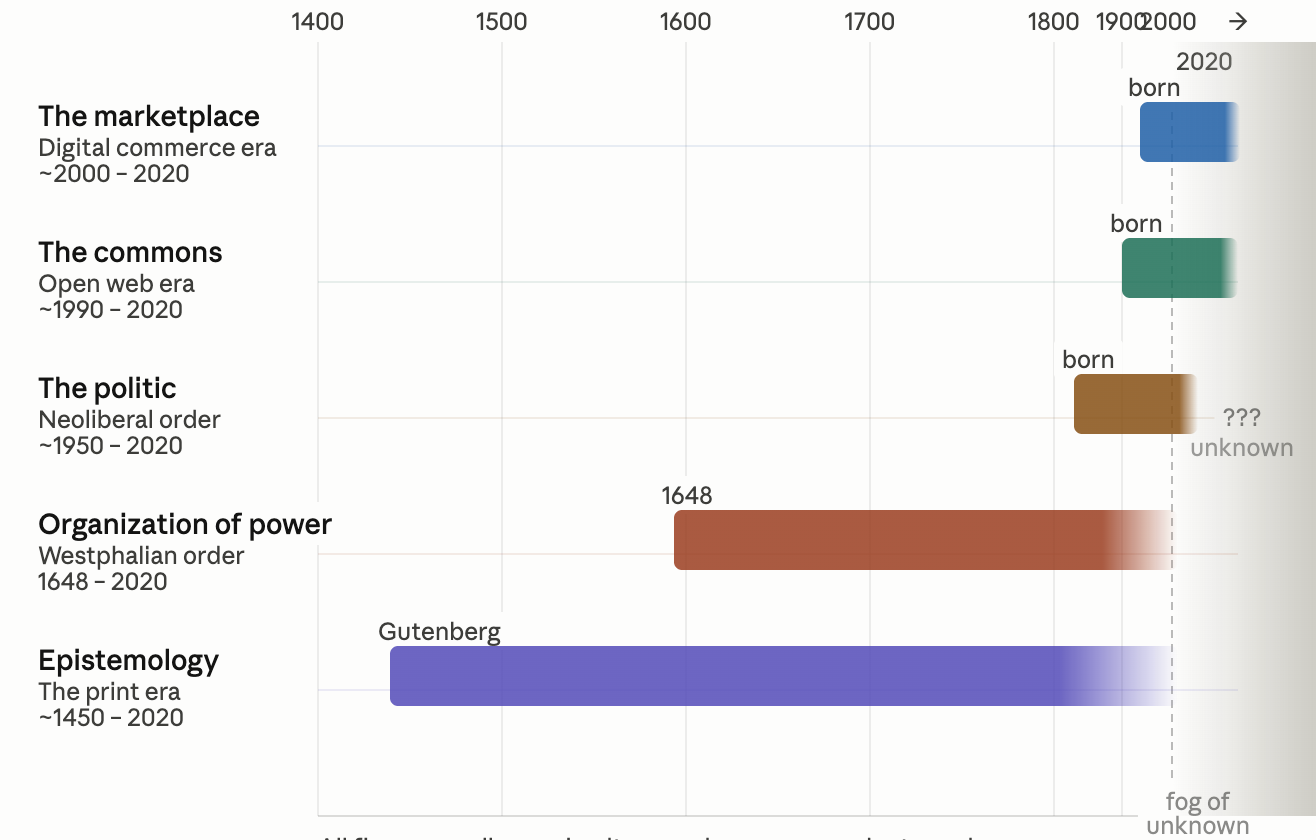
Five cliffs. All at once. Into a semi-permanent fog. So one thing is clear – we can stop waiting for things to get clear.
All Roads Lead to the Leader Now
We've been surviving in corporate America since after the Great Recession on a technocratic software-enabled late-stage Taylorism, where micromanagement is costumed as "Scrum" and more and more of corporate life is awash in surveillance tech.
The Amodei and Altman apology tour has commenced, and they are assuring us (to ensure their IPO enrichment and risk-dumping on the general markets) that they were just kidding about an AI-enduced employment apocalypse. That all those firms who shed 1os of thousands of employees and said "It's the AI!" were just kidding. Please buy their stock. Please. They're definitely not economy killers.
Please. I said please.
All joking aside, I actually think that economists, per Yann LeCun among many others, are probably more likely to know a little bit about the transition of labor. Most of whom are not predicting an apocalypse but a painful reshaping, with very real casualties, and likely more jobs at the end than we started with. Of course they will be different jobs. Displacing large swaths of people. The security of the jobs and their economic stability will change. The entry level is in grave danger. And if the entry level falters, the middle layer will be quick to follow. More jobs, just more insecure ones, is a complicated premise.
Their predictions reinforce the interregna. We are without a doubt in a major labor transition, due in no small part to the penta-interregna above. But the AI labor displacement is more likely the last gasp of this round of Taylorism, squeezing efficiency in the most inhuman ways, because large swaths of the managerial class have forgotten the requirements of human leadership, exchanging them for task management and dashboards.
It has been dry spell of 20 years since leadership, of the human kind, held center stage in the economic consciousness. The abandonment of "leadership" for "founder mode" and its weird cousin "=maxxing" over these decades has taken more than its toll. But the beauty of a breaking the back of anything is that in the absence of the thing--in this case human-centric organizational leadership--we start to recognize how much we've been missing.
As I've interviewed and worked alongside hundreds of leaders up and down organizations in the intervening years since Covid, nothing is more impactful than their their lack of resources, minimal exposure to, and unfortunately counter incentives to what it truly means to lead. Particularly in a time of near-permanent uncertainty.
The simple truth is this: No technology, no guru, no operating model, no project management tool, can solve for the chaos that extended uncertainty creates. Only a leader can solve for that. And dangerously, it is leaders who feel the pain of the uncertainty most acutely. You are left to be your own surgeon. On your own wounds. So that you can then, get to work on the organization that is holding itself together, waiting for the strategy of how to move through this wet woolen fog.
Any roads that lead to prosperity in the next fifteen years will move through courageous and humble leaders. Not managers. Not entrepreneurs. Not visionaries. You may wear those hats from time to time, but uncertainty puts a locked faraday cage around the radio signal of prosperity. And the only person with the key to that lock is a transformational leader.
Leader, what is demanded of you now?
The reason I asked for your permission to follow me in to this narrowing cave (before it opens up into the bright sunlight field) is because you cannot progress your work or your firm until you want to. Until you are ready to face all the ways in which you are standing in your own way.
Techno-management Taylorism is a system designed to let you stay the same. You are the ideas person and the risk-taker, but everything else is handled by a dashboard enabled, P&L monitoring command and control. For a time, when money was free, and we were two or three fewer interregna than we are right now, that could work. But it won't work now.
Now, two related things are true: you are the one you've been waiting for and its less cheerful corollary, you are the reason you've been waiting.
If transformational leadership is your only path forward, then what does transformational leadership demand?
- Readiness - Everything that is not working for you right now is that way because you and everyone else's best thinking made it that way. The barriers your venture is facing? You took all your gumption and created them. They are like the pot of a fast-growing houseplant. The soil no longer holds water. It grows leaves and drops them as fast they grew. Gently pull the once flourishing plant from its pot... and you have knots of roots turned in upon themselves, literally suffocating the plant on the exact growth that it once thrived in.
The disturbing truth of leadership is our best work produces our best resistance, and then we have to move back into transformation. Not improvement. This is not an age for improvement. Too much chaos. This is an age for strategic, surgical, put-on-your-oxygen-mask-first transformation. - Courage - If you are ready to move beyond sustaining and the cyclical pain of systemic problems that won't let go, that is a start, but it is not a movement. The chaos of the unknown, and the rootbound stabilizations we build to hold ourselves up in the chaos are designed as a system to keep you in stasis. You have, as everyone does, real resistance to making the changes that need to get made. but you've also tried a lot of other things. Tech, operating systems, the big hire, the sales campaign, the new product launch. The frustration of those starts and stops is leading most of your peers into despair, but if you have readiness, you can't fall back into despair. You've got to move forward in courage. You must enter the unknown without a map, only trusted guides, and trust in yourself to be guided along the way.
- Humility - When running anything, the strategic decision is to always put your most powerful energy against your biggest obstacle. The work of strategy, in part, fills in the madlib for those two variables: Most powerful energy vs Your biggest obstacle. Your biggest obstacle invariably has a big part of you in it. How could it not? You've touched every corner of the business. Your finger prints are everywhere. And before I can start gaming the board of what big moves I need to make, or more critically, who I need be to move others to their more open and transformational way of facing the work, I need to answer the fundamental question: How is this my game board? How did I allow these pieces on it? Why have I placed them in this way? Every element of our work, the cash flow problems, the shaky hires, the half-finished AI implementations are pieces on your board. Humility allows you to pick the most troublesome ones and start in the most logical place: Who was I being that put this on my board?
- Simplicity - A cocktail of Readiness, Humility, and Courage is a fog clearer. We live in a time so overrun by unnecessary complexity. And that complexity is fed by an optimization cult which only layers more complexity on to produce the illusion of an answer. When you take broken systems, scan them through an algorithm, then take that algorithm and feed it through a complex chat-managed AI agentic overlay, you don't produce simplicity, you produce volume and the appearance of simplicity. More chaos. More fog, now beautifully delivered across systems by your ten interconnected agents. An agentic layer can't give you simplicity. Only inner clarity can. The kind that comes from readiness, humility, and courage.
Three paths are emerging
As the confusion of the interregna ramps up, obfuscated by silly (and dull) gamesmanship about AI and its implications, three paths for leaders are emerging.
One, is the loud trend-chasing "I'm an AI expert as of yesterday" performance that has taken over LinkedIn and and the B2B influencer market. Somewhere in there are a handful of good ideas that are dependent on strategic clarity and good leadership. So even if you're path includes the accelerants of AI, you will need to have your foundations poured first. For this reason, I treat most of this as noise and theater from people who are very afraid to lose their livelihood because they are in impacted industries (marketing, tech, customer service) or spend far too much time online or both.
The second, is the bunker game. For these folks, they have either the financial wherewithal or the pain tolerance to just hunker down and hope to ride this out waiting for the "fog to clear." As I've enumerate above, for 99% of people this is losing strategy. The fog is not clearing anytime in the next decade, likely more. Many of these people who are playing the bunker game, are masking their strategy by writing deeply felt OpEds about what's wrong with the world on Substack trying to drum up enough paid subscribers to pay for Jimmy Johns. They are writing very smart things, in some cases. But if we accept the Gramsci framing of interregnum, it produces "monsters" and "morbid systems", but the monsters are not the point. They are just the sign that we are here, in the unruled in-between.
The last, the tiny quorum of folks that I am interested in, are probably a little bit afraid. They have the battle scars from taking risks in the past, from trying things that failed, from wanting to do more than just survive. They are worldly enough to know that somewhere in the noise there are some technological shifts that matter, but they are experiments at best for now, distractions in many cases. But they are unwilling to wait it out or perform their adoption of futurism for the crowds. And for some of this set, when you heard the call to transformational leadership, the priority to step into your own strength so that you could release the strength of others, something stirred in you and you thought, "Hell yeah. That's me."
History shows us that the future state, on the back side of this fog, depends on 3.5% of people being in a motivated, aligned, and engaged state of "hell yeah, depend on me" for us to create the next container of our shared growth. The next container of your venture in its various stages of root bind, the next expansion of your own personal capacity, opened up by humility and courage.
My primary call to action for you is to hear how much you are needed. And how much we all will depend on your leadership capacity growing; you facing your resistance. We need you to move out of the managerial optimization obsession, to the extent that you practice it, that's been handed you. We need you to step into getting more of the right support, to stand up into the fog of the unknown, unwilling to wait for the fantastical day when it clears.
As a more personal offer, I am contemplating putting together a new cohort of people to do this deep work of expanding their leadership capacity, owning their agency, and stepping into the unknown together. I don't have a fancy landing page with a list of inclusions, benefits and pricing to send you to. Cause I'm convinced that the right people won't want that. I want to hear from you about what you need and what you want and what is keeping you stuck. And if we find enough of the right people, we'll build something together to get stronger--together.
If you've felt any inkling of "this is me" in this email, would you reply? Share with me what you need to step into the fog, if that's too vulnerable a first step, just a one sentence reply, "I think you were talking about me."
Until then... forward, forward.