Can credibility beat the algorithm? Sure it can. Here's how.
If you’re in the business of building real trust—premium, custodial, collaborative trust—can you actually win in this environment? Can credibility beat the algorithm?
Yes. But not by playing the algorithm’s game.
Edition 139 - The starting line for building a trust-based pipeline of opportunity
Most businesses I know that will say they are trust-based do very trust breaking things. They don't mean to. It's not their intention. But we don't live and die in the commercial coliseum by intentions, we live by actions and their outcomes.
Financial advisors that spew out generic content with hollow hooks like "Want to learn how to do this for yourself? Get our customized comprehensive wealth plan!
Software companies that funnel you through digital BDRs and automated email funnels when all I really want to know is can you solve my problem.
Non-profits that waste every ounce of attention they get announcing their good deeds, rather than explicating their outcomes.
Independent consultants who just want to shove you into a catch all retainer for their newly minted "fractional" service model.
Half-burnt bridges everywhere. And we've been training for this Fahrenheit 51-level arson for decades, and it all goes back to THE FUNNEL.
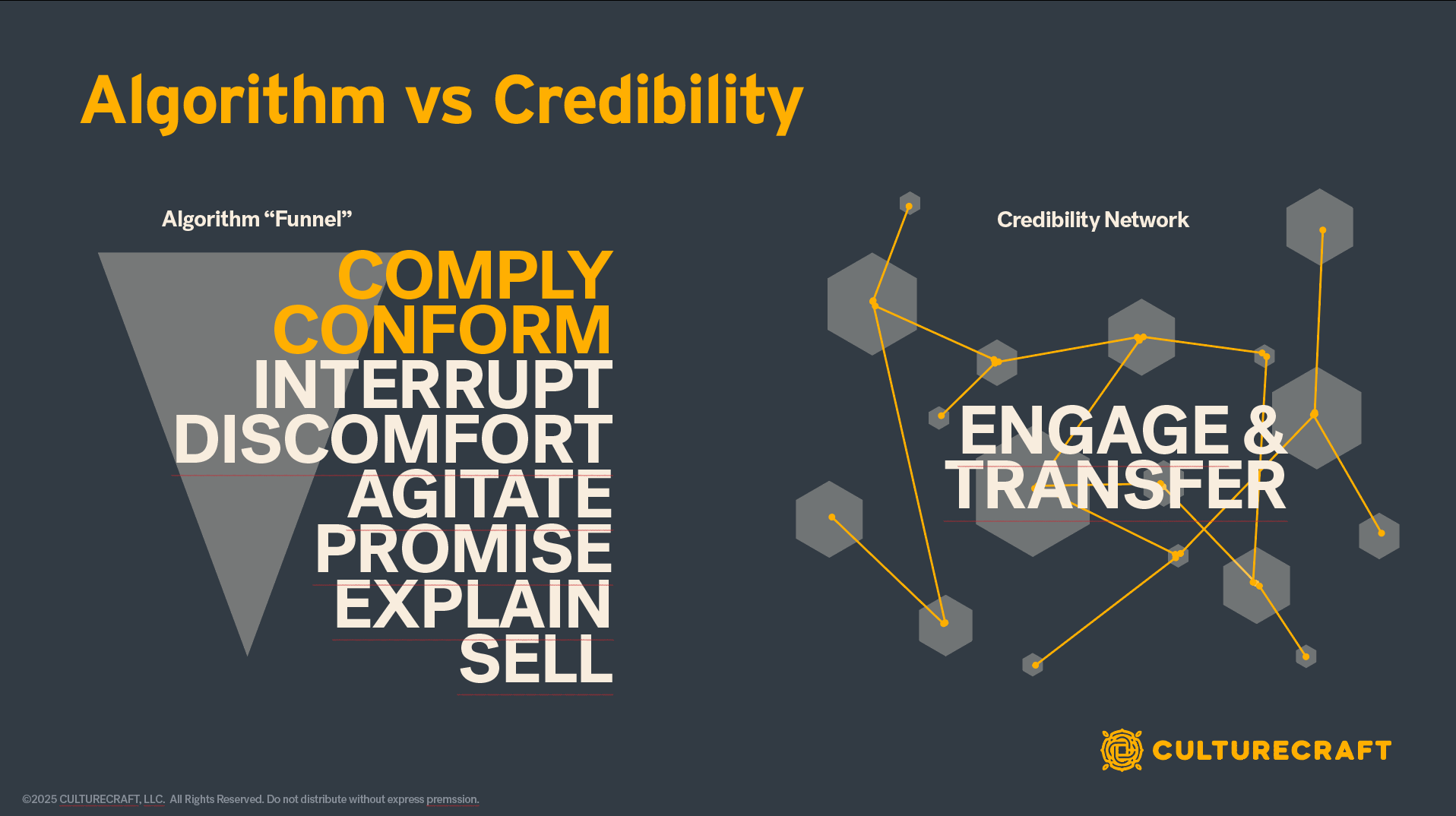
The algorithmic funnel forces you to comply and conform, interrupt and descomfort, basically create chaos and noise for your customer with digital handwaving, and then you have to sell into that absence of trust. Replanting your strategy in a credibility network allows you to borrow tools from the digital space, but not live by its rules.
Funnels Don't Exist
Let me start with the thing nobody in digital marketing wants to admit: funnels don’t exist. I know. We’ve spent fifteen years massaging them, buying software to surveil them, making up acronyms for them (TOFU, MOFU, BOFU...STFU, if you please), and defending them in conference rooms. But funnels are a metaphor invented by SAAS companies to justify software spends to CFOs. They are not, in fact, how human beings make decisions.
What actually exists, what has always existed, is networks. Human beings embedded in relational hubs and spokes, exchanging credibility and meaning. We are on a 40-year decline in trust across every major institution. That is not a marketing problem. That is a civilizational condition. And solving for that trust cannot be done (in fact is further degraded) by creating one more lead funnel, lead magnet, one more noise-making content marketing machine.
So here’s the question I keep coming back to: If you’re in the business of building real trust—premium, custodial, collaborative trust—can you actually win in this environment? Can credibility beat the algorithm?
Yes. But not by playing the algorithm’s game.
First, Know Where You Live on the Barbell
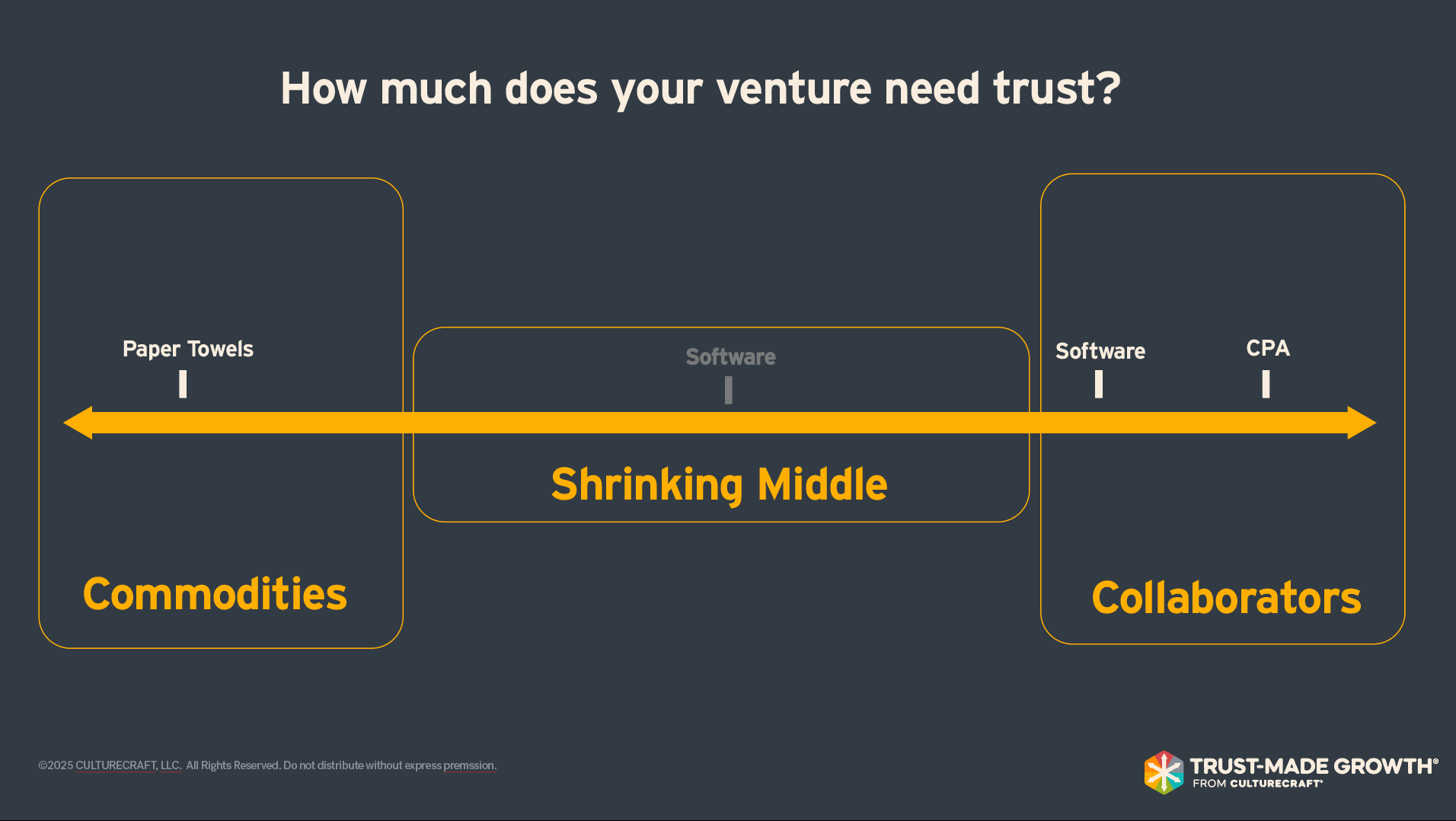
There’s a spectrum here, and it matters enormously where your offering sits on it. On the far left: commodities. Cheap, interchangeable, sold in volume. Nothing wrong with commodities—they lubricate economies. But there is enormous pressure right now to push everything into commodity territory, and that pressure has been building for fifteen years. Part of the mythology of digital marketing was that you could price and deliver a premium product but sell like a commodity. Premium margins, commodity-speed pipeline. What a dream.
On the right side: collaborators. Custodians. These are the offerings that, if they disappeared tomorrow, a part of who you are or how you function would actually suffer. Your CPA. Your business coach. Your CRM. The person who holds something important for you. These relationships are built over long lead times, carry deep relational equity, and command genuine premiums—because you’re not paying for a product, you’re paying for the risk mitigation of having someone or something trustworthy in your corner.
The middle is collapsing. If you’re in it, you need to decide which end of the barbell you’re heading for. Lots of reasons for this that I've discussed in previous newsletter editions, but the bottom line is, if you're not sprinting to one side or the other, you're in No Man's Land.
The Six-Layer Dip of Reality Distortion™ - or - Why we can't find each other
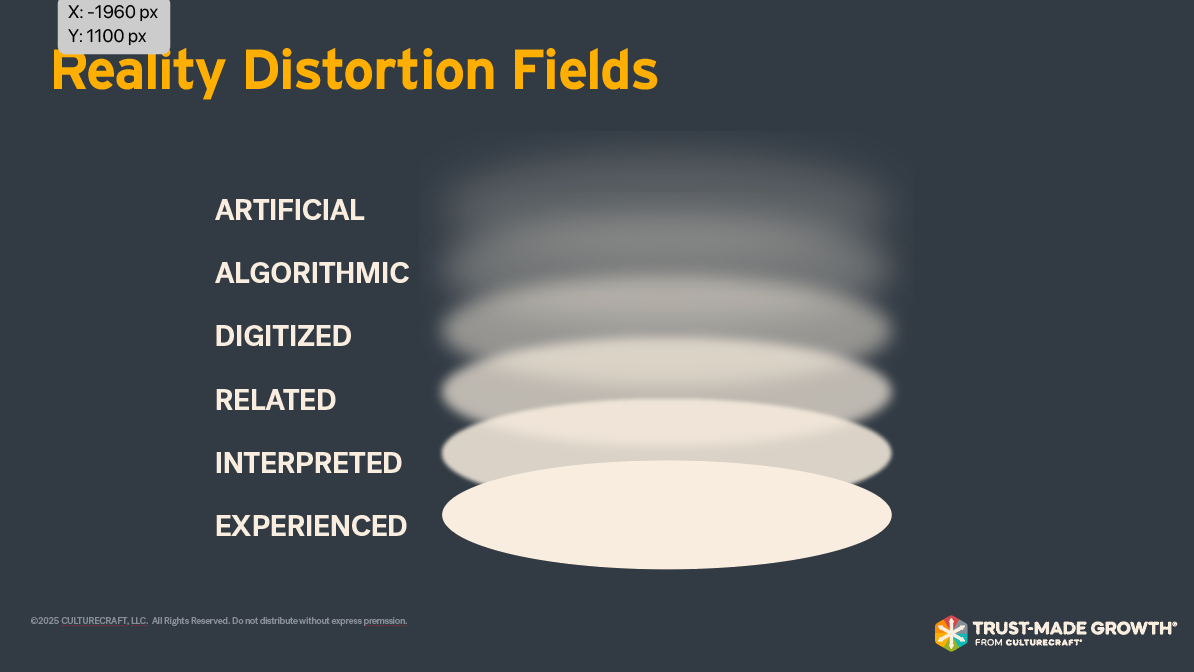
I used to train on that old famous communication framework: Sender message, Interference, Receiver understanding, to help salespeople understand that there's a layer of noise between them and the person they're talking to. Today, that "Noise" is seven layers deep, moving through six different distortions:
One - Experience. The thing that actually is happening. What's happening to you isn't what's happening to me. If we want to trust, we've got to sort that out.
Two - Interpretation. My past, my assumptions, your values, your narratives. All distort our ability to connect. Totally solvable, humans have been doing it for millennia.
Three - Relational. Other people are involved. Telephone games and triangles distort further.
Four - Digital. Content types, Hyper links. Blogs. Videos, Calls to action. The medium is the message.
Five - Algorithms. Selecting from the digital layer. Deciding what gets surfaced. Optimizing for engagement, not truth.
Six - Artificial. Deep fakes. Hallucinatory summaries. An email that looks like it’s from Jim, written by Jim’s GPT. At scale. On every screen. All the time.
No wonder we can’t find each other. Your message is fighting through twelve layers of distortion (your six and your customer's six are not the same) before it gets anywhere near a human decision. And the algorithmic funnel—the one every marketing playbook is still built on—makes this worse. Comply with the taxonomy. Conform to what gets through the filters. Interrupt somebody. Produce discomfort. Make a promise. Sell.
And you're competing against the algorithm. You may be able to trigger some agitation, call someone to action, but that agitation is best soothed by more scroll, more feed, more content. The algorithm wants you to trigger people, so it can use its greatest ability - dopamine addiction to soothe them and keep them on platform, not on your website. You’re not just up against your market competitors. You’re up against a dopamine machine. And you will lose that fight most of the time.
Understand the reality distortion field
If the last 250 words or so made you go... huh, I think I need to think about that more, you can join me on my brief 15-minute YouTube deep dive on the Six-Layer Dip: The Internet's New Permanent Reality Distortion Field
I’ve heard it from CEOs, from sales leaders, from founders: “I can’t build a pipeline until I can get attention.” You have to let that go. Completely. Because what we’ve been calling an attention economy is actually an addiction economy. And unless you’re selling addiction, you are not going to win by chasing it. (Ketamine anyone?)
What succeeds again and again, and we're seeing this in real time with independent firms, leaders and large firms alike, that when you let go of attention seeking, commit to deep focus on a particular community and its problems--pay attention--you've changed the rules of the game. Out of funnels into networks, where good work can get done.
Where can I pay attention? Who do I actually want to show up for? This is what trust-based pipeline is built on. Not your content calendar. Not your impressions dashboard. The quality of your attention.
Your firm has to commit to falling in love with a very narrow psychosocial reality. Not an ICP. Not a persona. A real answer to: who are these people, how do they see the world, what do they believe, what keeps them up at 3am, and if I put them all in a room together, would they start nodding at each other? That’s your territory. And it has to be narrow enough that you actually care about it. Not “I spent 15 years in telecom so I’ll call my telecom contacts.” Do you want to talk about telecom problems for the next ten years? If not, dig for the Venn diagram. Maybe it’s not telecom—it’s leaders whose industries are being marginalized by innovation. That’s interesting. That’s a psychosocial reality you could actually lean into.
People with a shared psychosocial reality exist in similar networks. Those networks are findable. And unlike algorithmic networks, human networks operate by rules that haven’t changed in fifteen thousand years. They’re based in our reptilian brain. You cannot manipulate them with a platform update. The beauty of the trust system is that it’s boring to disrupt.
The three prerequisites to trust
This pivot from attention seeking to attention giving (Rule #1 in my forthcoming book The Damn Rules) has three structural pre-requisites if it's going to work. This is where you need to begin.
1. A low-risk credibility ecosystem.
How do people find out about you and understand your credibility without having to pick up the phone? This is not a funnel. It’s an ecosystem. A newsletter. A podcast. A seminar series at the local library if your prospects are all local. A mastermind you run for people in your industry. It needs to be strategic, consistent, and obsessively targeted toward your core community (that psychosocial focus from above).
The key word is low risk. Not a sales webinar. You’ve all been to a sales webinar. Halfway through, someone goes, “I’m not quite ready to reveal the solution, but for those who join us at $2,999 a month...” That is not credibility building. Credibility building is showing up on a Thursday afternoon to talk about things you care about with people you care about, and asking nothing in return but their willingness to engage.
Do it consistently. I am genuinely bad at this—I get incredible feedback on my newsletter and still sometimes go four weeks between editions. It kills my credibility. Don’t be me. The consistent, predictable showing-up is the trust signal. Not the brilliance of any individual piece. (I'm working on it. C'mon.)
2. A risk-adjusted value ladder.
We are in the lowest-trust era in recorded human history which means: I am not going to trust you right away, no matter how trustworthy you believe you are. I need little incremental transactions of trust and value.
If someone reads your newsletter, they have a teeny tiny bit of trust. Does your value ladder have a teeny tiny bit offering? If the smallest engagement you offer is a $10,000/month fractional contract or a six week planning process where I have to give you all my personal data or a long drawn out discovery, there’s an enormous trust leap with nothing to stand on. You need steps. Small commitments that earn the next level of trust that earn the next. Build the ladder so there’s always a next rung that matches exactly how much trust someone has in this moment.
3. A reversed-polarity network.
If we’re honest, most of us spent the 2010s and early 2020s looking to our network for attention. Who’s liking, who’s clicking, who’s opening? All the attribution systems—most of which turned out to be garbage—trained us to measure how much attention we were getting instead of how much we were giving.
Flip it. Go to the meetings. Attend the conferences. Befriend the smart people in the space. Build a coalition. Show up in ways that demonstrate you’ve been listening. Paying attention is a long game. Stealing attention through addiction networks is a short-term game. Short-term games are for the commodity end of the barbell.
WANT TO GO DEEPER?
I covered in depth all of this in my most recent free training sessions for members of my community, The Trust-Made Guild. If you want to really start the process of pivoting back to trust, check out the recording at the link below.
Here’s what happens when I walk a CEO through this: you can watch the anxiety surface in real time. Oh God. I have to pick specific people. What if I pick the wrong ones? What if I burn my network? What if I’m exposed?
I have to have low risk, low cost offerings? What if we can't scale it?
Maybe if we just produced more content. Should we do a podcast? (As a person who has a podcast let me be clear... most of you should not do a podcast.)
All of that is vulnerability. And if you don’t have resources to hold it—a peer group, a coach, your own practices, something—you will revert to the dopamine machine. That’s how addiction works. Vulnerability shows up, and the algorithm says: here’s a shortcut. Here’s a vanity metric to make you feel better. Here’s a reason to post instead of call.
But vulnerability is the true trust pre-requisite. It's how people know they can trust your firm, your offering... you. Because you aren't armored up with digital games and click-me coercions. You are showing up in ways attuned to them, their point of need, their small, but growing capacity to trust. Their relational spaces.
If you have questions about your firm's trust readiness and next steps on this journey our 30-day Growth Check might be exactly what you need.
Getting to the root of brain rot: the business consequences of an anti-thinking life
The costs of the attention economy aren't just personal: when a culture stops thinking, stops tolerating friction, and outsources its judgment to machines, the business consequences are real - and they're only beginning to show up.
4 min read
Jan 15
Everything is gambling now
The data-driven revolution has produced a self-induced digital Dark Age, where we're fumbling around having to build ventures, communities, and institutions with almost no clear idea what happens next.
7 min read
Dec 19
The 2025 Good List
2025 will go down in history as the year online firmly lost touch with human reality. For this reason and many others, I have so much hope.
11 min read
Nov 03
Stop Playing the Refs
We are not nearly as vulnerable as we feel.
Most of what we fear isn’t real; it’s rehearsed by algorithms and adrenaline. We still have agency — just not in the places we’ve been told to look.
4 min read
Oct 09
Marketing truth in a lie factory
The gap between digital and reality is now an unmanageable chasm. If it's online, there's a very real chance it's not real. And that changes everything.