Misdefining "trust" and the cost of wasted attention
Trust seems like it's about defining right and wrong, but it isn't. It's a nervous system response. We distrust social media platforms because our bodies read them as unsafe, and then the tech is designed to override that "unsafe" response. And leaders have to shift their focus in response
Edition 140
TL;DR
Trust seems like it's about defining right and wrong, but it isn't. It's a nervous system response. We distrust social media platforms not (primarily) because they're evil, but because our bodies read them as unsafe, and then the tech is designed to override that "unsafe" response.
This week on the pod I invited Jacob Warwick to talk about deleting his 30k person LinkedIn and build his business around reclaiming his attention. Not a template for everyone. But it raises a question worth sitting with: how stingy with your digital attention can you be, and what would that free up?
Today's newsletter isn't about the pod. But I do hope you give it a listen. It's about the realities that make this pod important and possibly incendiary.
The platforms make self-limiting hard. They're designed to. Their job is to absorb as much of your business and focus as you'll allow them. They are totalizing forces, not marketplaces for transaction. The courage it takes to step back is the same courage that makes someone trustworthy in the first place. In all my coaching work, the thing blocking smart leaders isn't skill or pricing or readiness. It's fear. The antidote is the courage to select, to ignore, to chase your singular achievement, not the mass market one being offered on the internet.
What will courage ask of you?
Damns Given Episode 2.02 with Jacob Warwick Podcast Episode Links: YouTube | Apple | Spotify
The Modern Problem of Trust
Framing my work as "trust-made" and leading others to do the same has been a bit of a minefield, but one worthy of the navigation.
Trust is a mutlivocal word, full of meaning, and loaded with assumption. I use it specifically for that purpose. Because Trust is so personal and so embodied (it's origins are neurological, not emotional or even moral) by pinging people's perceptions of the word itself, I've been able to observe What You Want which is to providing real value and real service.
The internet, since about the advent of the iPhone, is not about What You Want. It's about adtech creating enough psycho-chemical triggers to induce you and I to continue to share as much data as possible which is then resold to the highest bidder—from Palantir to ICE to BulgeBoy men's enhancement undergarments. To win on the internet is to play by its rules. And its rules and definitively anti-trust.
That is the ultimate difficulty. I am writing this on the internet. You will probably find it on the internet. (Though given the 1:1 network quality of SMTP protocol at the base level of email, it doesn't play by internet rules, thank God.) You are likely reading this with the part of your brain that reads internet things. Scanning. Breezing past nuance. Looking for a reason to fight or flight.
If, by some wonder of time spent together, in words or in person, you might build up enough tiny nubs of trust, you might, when you see it in your inbox, switch on your reading brain. Your vulnerable brain. The one that could be influenced, or challenged, or awakened with that most fragile of things: Hope.
Trust fires up neural pathways. It widens our senses. It opens the aperture of the world we are willing to see. And without it, out of an evolutionary ingrained set of rules we've carried genetically for millennia, we shrink the world to its smallest view, focus obsessively on where we perceive danger, raise our hackles, and snarl and the smallest sign of disruption to our ever-shrinking sense of safety.
Sounds a lot like the internet. And frighteningly, the IRL world is starting to look more and more like the internet.
Trust Alternatives
Vendors in the digital marketing and media spaces are starting to talk about trust. After spending decades complicit with the exact systems that have degraded our ability to see or hear each other online, these industries are trying to retire from careers in pyromania for a second life in firefighting. I respect the pivot, everybody gets the right to "know better, do better." But their conclusions are, so far, not sufficient to solve the real fundamental problems for leaders or their ventures.
Often they are building off hyper-simplifications of trust that play well in the internet discourse, but will only scratch the surface. By my view they show up in three forms:
Trust as Moral Purity: Purity testing is one the internet's great legacies. Depending on what community you run in, a set of "good" behaviors are assumed but rarely delineated, and then policed. In extreme forms this has produced various forms of vigilante justice, some reasonable accountability here and there, and a lot of hand-wringing on all sides about "cancel culture." Trustworthiness in this context is a short-hand for moral alignment. You are trustworthy if you think is good what I think is good. This can only go so far. Framing trust as moral purity (by whatever your moral purity test is: environmentalism, B-corp status, labor policy, patriotism, etc.) only accelerates what the algorithmic layer of the internet already does well: putting us in ideological silos so it can sell us things we don't need, to solve problems we don't have to satiate feelings we'd never feel if we just logged off.
What do you mean by "AlgorithM" and "AI" layers?
Because every venture and leader is at base level in the communication business, you have to understand what the layers of distortion you're trying to shout through are and how they work.
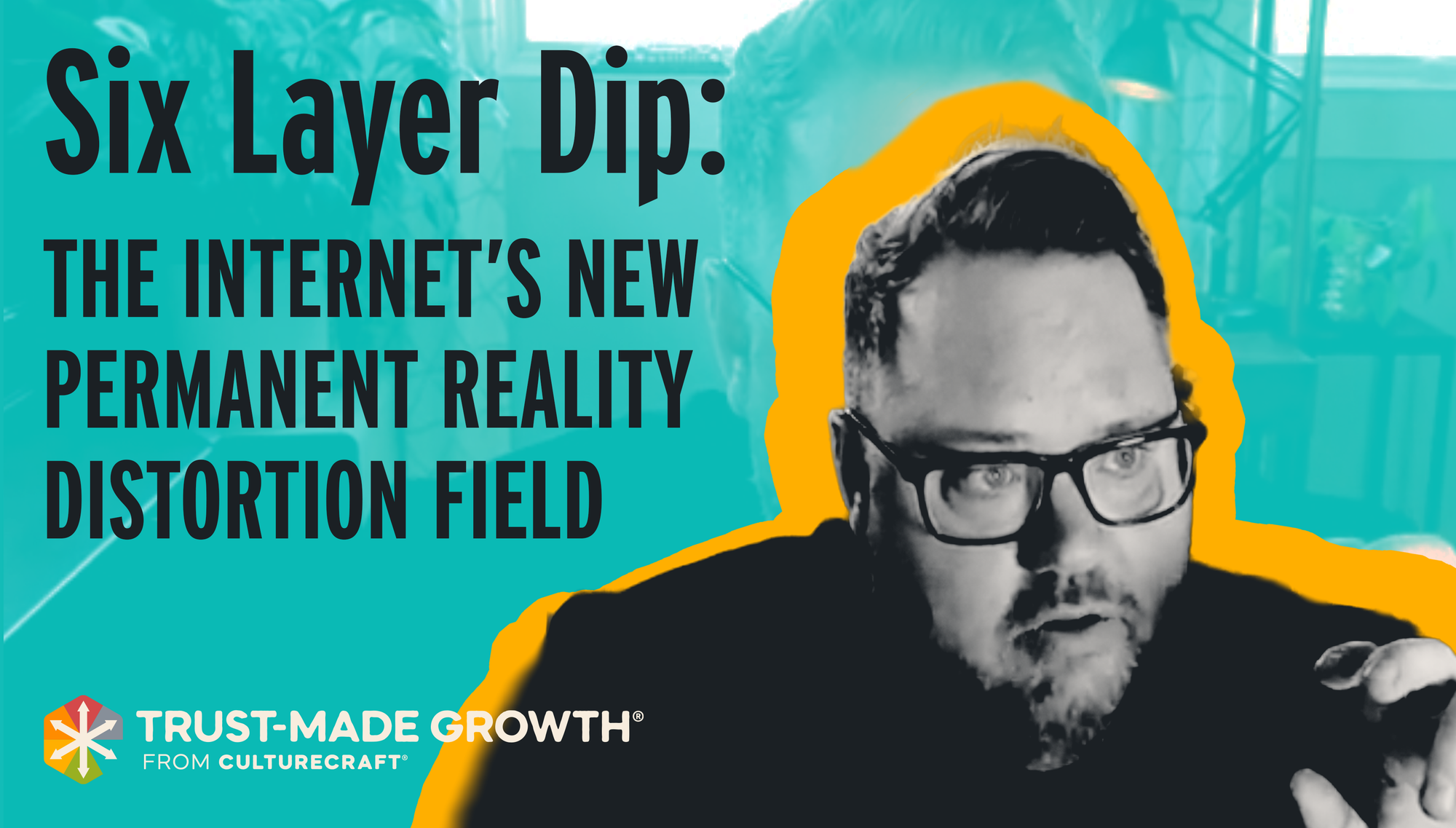
I did a brief video to explain this called "Six Layer Dip." Take a look.
Trust as Informational Accuracy: I'm seeing this one more and more as folks who want to be positioned as "the good guys" in marketing (this is a good thing, we want people to want to be good guys and gals). And while the general consensus of on the AI layer of the internet is raising alarms, the concensus is nowhere near as dangerous as the reality. "To trust, we have to believe what we're seeing is real," has become a rallying cry against deep fakes, bot sources, and general bad data. Businesses are being challenged to upgrade their data source hygiene. These are all good things. They just only have an adjacent relationship to trust. We can (and sometimes should) trust sources that are not fact-purveyors but storytellers, compass makers, and seers of unverifiable things. The wisdom of the world, the kind that produces time=defying value, won't be found by the fact checkers. Factuality is essential but not sufficient.
Trust as "Authenticity:" There is a cohort of Millennials (broadly) who believe that their business value is in direct proportion to their willingness to perform in cringeworthy ways. Hyper doses of irony. Maximalist sincerity. The willingness to to treat everything through the lens of the political. They are, in one view, trustworthy because of their radical authenticity. They don't care what the naysayers say. While some of this may be true, its also been done before to detrimental results. There is a not-so-subtle egoism that easily threads itself into the "authenticity" code that's really just an attempt to bend culture into their own image. I was GenX. I know first hand how this goes.
What I mean when I say "Trust"
The Trustfallen society and marketplaces we live in stomp on our last nerves not fundamentally because they are immoral (though that case could be made) or misleading (although... look around) or even performatively inauthentic.
Trustbreaking is neurological. It's in our bodies. It's the reptilian brain checking everywhere and everything with one singular question:
Will you harm me?
Something breaks trust but because our bodies, our nervous systems, our natural genetically endowed safety valves, read it as harmful. This reading is contextual and personal, though themes exist. The power in building trust-made is in understanding those themes and action after action after action building to reinforce neurological calm and psychological safety.
The thesis and proven result of our Trust-Made Growth® Ecology for Leaders and Ventures is that this formula is solvable, repeatable, and true across contexts.
Reducing the "Harm Alarm" with the very specific people who you want to build relationships with is the job. That requires radical specificity, because we don't all define harm the same way. We carry it based on where and how we feel vulnerable. While internet commerce exists to find vulnerability and treat it like open wounds from which to extract sellable life force, trust-made firms recognize vulnerability in others because they are students of it within themselves.
Trust-made firms know what it is to trust. To live with their own vulnerability to the changing winds, and make strategic decisions therein.
Trust is about how we carry vulnerability. Every human feels vulnerable some of the time. We can numb it with false confidence, alcohol, cynicism, moralizing, and a million other things. But to trust (and be trusted) we have to allow ourselves a level of vulnerability that is required to be trustworthy.
All of this was on full display this week in my most recent Damns Given Podcast Interview with Jacob Warwick. If you haven't listened yet, I hope you'll go back and do so (though not required to glean a little goodness from this newsletter) It's already raised many questions for our listeners about what consistutes trust and good business. It's also been a ripe place for people to put words into my mouth I didn't say.
Ep 2:02 - Radical Clarity and Quitting LinkedIn with Jacob Warwick
Trust and the Digital Platforms
We all have to ask big questions about where to place our time, and what it means for our capacity to trust. How stingy with our digital attention can we be... to free up our creative will do more of what we're here to do? There is an agressive ceiling to how much trust is available to you when your primary point of engagement is digital platforms. What is it worth to you to break through that ceiling?
I think these are questions that are brewing hotter and hotter. It's now common place for smart marketers to talk about intentionally limiting how many digital platforms you're on. About limiting the scale of your website. About doing cost-benefit analysis between these digital games and their more analogue peers. We haven't had these conversations in any meaningful way for 20 years. And now they're here.
But the digital landscape is so heavily incentivized, so addictive (as Jacob makes clear in the podcast) that it takes real courage self limit. For yourself or your venture.
The Strategic Role of Courage in Leadership
When I'm coaching leaders, individual work, group work, across all kinds of industries and stages, the resistance I keep running into isn't skill. It isn't readiness. It isn't pricing or positioning or any of the dials we spend so much time trying to turn. Those things matter and we can make real progress on them.
At the center of it, the biggest thing stopping smart, strategic, good leaders moving past the limits and uncertainty of the current marketplace is carefully directed and applied courage.
I see it in professional services. In software. In solopreneurs. In higher education. We have had the courage quietly extracted from us, and most of us didn't notice it happening because the extraction felt like efficiency, or innovation, or strategy.
It's going to take something special to build the things worth building right now. And I think that something is the willingness to ask yourself, genuinely and regularly:what will courage ask of me?
Not bravado. Bravado is everywhere. We have plenty of people blowing things up with other people's risk to prove how fearless they are. That's not what I mean.
I mean people who have deep values and then make hard, quiet, sometimes invisible decisions to see those values actually show up in the world. The courage to have the conversation before the website is ready. To delete the platform when it stops serving you. To say the thing that costs you something.
I didn't interview Jacob (or any of our guests) because I think their way is the model for everyone. I interview them because I think they give a damn about something and that damn giving allows us to discover something about trust.
Trust is inaccessible and arguably pointless until somebody cares about something enough to take a risk.
They step off the 2D addiction digital gamesmanship algorithm in a way that businesses who just know how to game attention don't and can't. You can spend the next six months figuring out how to get ChatGPT to mention your company in an answer, but if what it's mentioning is just a game, a posture for bots to scrape over, then you're going to get the same distrusting response we've all become accustomed to.
The cynicism of our age won't break because we got the website copy right. The cynicism of your prospects won't abate because you built the best email sequence. You're going to need to coax them out of the fight, flight, and freeze responses that we've all been conditioned into.
Courageous people are trustable. Not because courage is a brand or a positioning statement, but because courage is what it takes to step into vulnerability. And right now, in this particular season, if you want what you're building to be trusted — your business, your community, your practice, whatever it is — it is going to require that kind of gutter-level courage more than almost anything else.
I hope you find some of it. I'm looking for mine too.
— Nick
Give a Damn.
Stay brains on, heart open, forward progress.
You might also like
Mar 09
Can credibility beat the algorithm? Sure it can. Here's how.
If you’re in the business of building real trust—premium, custodial, collaborative trust—can you actually win in this environment? Can credibility beat the algorithm?
Yes. But not by playing the algorithm’s game.
9 min read
Jan 15
Everything is gambling now
The data-driven revolution has produced a self-induced digital Dark Age, where we're fumbling around having to build ventures, communities, and institutions with almost no clear idea what happens next.
7 min read
Dec 19
The 2025 Good List
2025 will go down in history as the year online firmly lost touch with human reality. For this reason and many others, I have so much hope.
11 min read
Nov 03
Stop Playing the Refs
We are not nearly as vulnerable as we feel.
Most of what we fear isn’t real; it’s rehearsed by algorithms and adrenaline. We still have agency — just not in the places we’ve been told to look.
4 min read
Oct 09
Marketing truth in a lie factory
The gap between digital and reality is now an unmanageable chasm. If it's online, there's a very real chance it's not real. And that changes everything.