How you think about AI has a lot to do with how you think about chaos
The long list of things outside your control feels like it keeps getting longer. The question is, how do you keep that chaos outside, so you can make strategic, trust-made, growth decisions on the inside? Surprisingly, this has everything to do with how you think about AI.
This edition is released in conjunction with the mos episode of the Damns Given Podcast where I interview technologists and business transformation resident genius, Amy Carrillo Cotten. You can watch our conversation on YouTube or listen on Apple or Spotify.
In this written edition, I pivot off the software of it all to remind us about how transformation really happens and how trust-made ventures deal with disruption.
Shall we ride? We shall. –
There's a particular kind of noise that happens when an industry that built its identity around disrupting everything else suddenly becomes the thing being disrupted. It's loud. It's defensive. And it's producing a lot of press releases that smell like spin. Software started as the disruptor, and now it's gagging on its own gains.
Almost all readers of this newsletter are either buyers or makers of software, and so you may know something of which I speak in this week's edition. But even if you feel disconnected from the business of code, you know what it's like to try and grow in the context of chaos.
The long list of things outside your control feels like it keeps getting longer. The question is, how do you keep that chaos outside, so you can make strategic, trust-made, growth decisions on the inside?
Well, as always, the headlines offer us a gift.
Two things happened last week that I think are worth paying attention to, not because they're shocking, but because of what they reveal.
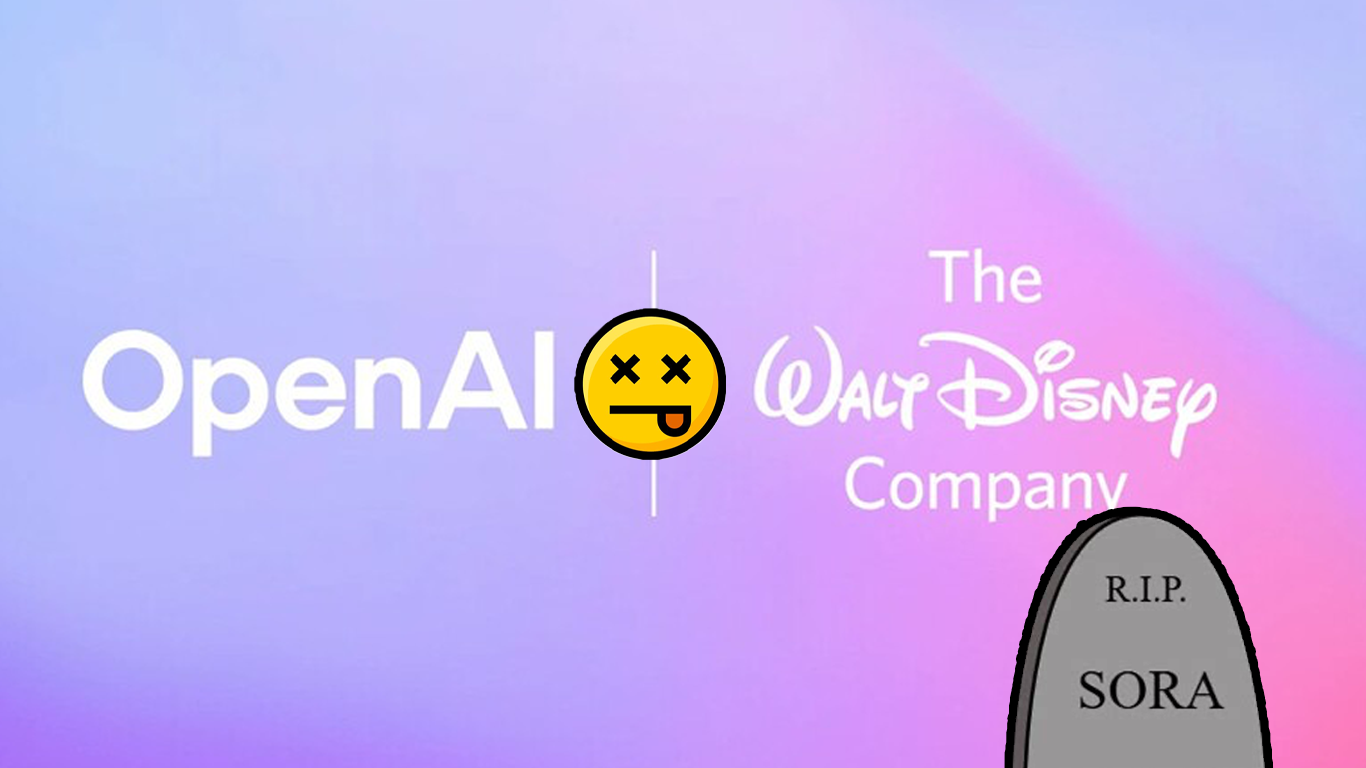
OpenAI pulled the plug on Sora, their AI video platform, without so much as a heads up to Disney, who had very publicly climbed aboard that particular train. Choo Choo, splat. Poor Mickey. And poor Josh D'Amaro - what a week to be your first week a CEO. Your predecessor tried to dryhump the biggest hype machine in town, only for it to collapse in a pile of hype. AND your TV people decided to move a known criminal from one headline brand to another, just in time for video of her throwing a chair at a child to be released. Ah, modern media. The gift of cautionary tales keeps on giving.
But the real crown goes here to OpenAI, the largest, most media vaunted, biggest, company in the largest, most well funded disruption in the history of the corporations continues to give a master class in distrust. Something called "How to be seen as the antiChrist in 12 easy lessons and still fail to launch a product people actually like..."
Speaking of gifts, the New Mexico court ruled that Meta and YouTube are liable for targeting a child with addictive behavior. Is this the beginning of a Big Tobacco level reckoning for the internet's favorite child (and adult) addiction machines? Remains to be seen. Meanwhile Mark Zuckerberg is replacing himself with an AI CEO. Think of the trillions that will be saved not doing whatever he thinks is a goo idea. The guy has a negative ROI so large in the last ten years it would make your grandma weep. And she doesn't even know what ROI is.
Lessons for marketing are rich in detail and scope. Advertising (paid or organic) on these platforms is now sort of like putting signs for your mansion for sale in the slums. The context tells you what it's worth.
Social media has been the business model for AI. Give away stuff for free, suck in users, make it worse, add extractive layers, and create addiction machines that dehumanize the users. Up and to the right, right?
Maybe not.
Neither of these is an isolated event. Both of them are symptoms of the same underlying condition: we built a lot of things assuming growth happens in a straight light up and to the right. Except it never does.
Let me explain what I mean by that.
Lines are superimposed; real life is a circle
Nothing in nature moves in a straight line. Nothing in business really does either. We retrograde the data, we pick the right start and end dates, we smooth out the extremes, and we produce something that approximates a line on a chart. And then we build entire industries around the story that line tells. And foolish leaders say, "Look at this straight line I invented... now what are YOU gonna do to continue its imaginary course?" You, of course, are not one of those leaders.
The AI story has been a line story. Up and to the right. Get on the train or get left behind. The myth of inevitability — and it is a myth — has been doing enormous amounts of free PR work for a small number of companies while the rest of us scramble to figure out what we're supposed to be doing about it. It's not that AI isn't disruptive, its just that it doesn't do hardly anything the hype says it does, and what it does do requires a level of sophistication in deployment and organizational design that almost no venture has in house. (Something we like to solve for, if you wanna give my team a call.)
One Fortune 1000 firm leader said it best this week: "Our IT team deployed AI as if it's an IT product. But it's not, it's a strategy product. And now we've got a mess to clean up." Time to call in a Philosophy Major to disentangle this knot of moral and epistemic hazard.
What reliably exists, what has always existed, are circles. Cycles. The organic rise and fall of things that are breathe their way through change and disorder, composting it into healthy new reality. Healthy systems breathe. They move in and out. They respond. Inorganic systems — the ones trying to force the line — become fragile. They require enormous effort just to maintain stasis, like a bridge. A bridge is an incredible feat of engineering. It does exactly one thing. It cannot become anything else. And if that thing is no longer needed. We blow up the bridge.
You cannot afford to be building a bridge.
Change out of chaos is trickier now than ever
I had the pleasure this week of talking with Amy Carrillo Cotten, one of the sharpest transformation specialists I know — specifically in the software space. And what she helped me articulate more clearly is the question that every software leader, and honestly every leader period, is being asked right now:
Have you created the conditions for change, or are you just absorbing the conditions for chaos?
Those are not the same thing. The pressure being put on organizations right now—from boards, from capital, from clients, from the relentless LinkedIn noise machine—is to let all of it in. Adopt early. Test everything. Move fast. But the more you let in without a framework for what you're actually solving for, the more chaos you're importing, not innovation.
The leaders I have the most respect for right now are...
the ones asking harder, slower questions. Not what does AI do? but what does my organization actually need, and does this serve that? Not are we moving fast enough? but fast toward what, exactly?
Moving past hype and PR
Here's the thing about those layoff announcements, the ones where a CEO steps to a podium and says we're eliminating four thousand positions because AI now does their jobs. Do the research. Most of those layoffs were coming anyway. The AI framing is a gloss. It's using the language of inevitability to paper over business decisions that have other, messier explanations.
This is what happens when we use technology to divorce ourselves from reality rather than to see it more clearly. Science, real science, has always been about becoming a better student of what's actually in front of you. The generative AI era, at its worst, is being used to do the opposite: to produce a more convincing version of whatever story we wanted to tell anyway and then by force of volume and speed bend reality to its will.
The leaders who are going to come out of this period with something real are the ones who become obsessed with reality. Not the narrative. Not the press release. Not the LinkedIn take. What is actually happening, in this organization, with these people, toward this specific problem?
The impacts on marketing
Every technological decision a leader makes now has trust implications. That's not a soft, philosophical observation. It's a practical one. As the digital layer becomes primarily a vehicle for surveillance and advertising technology, the software that swims in that water has to reckon with what it's actually doing to the humans on the other side of the screen.
The court ruling about Meta and YouTube and teenagers is a beginning, not an end. The harm of addictive digital systems goes far beyond young people's unfinished prefrontal cortexes. It touches all of us. We protect teenagers first because that's where our cultural consensus is clearest. But the question of whether these systems are a net force for good or a net force for harm — that question is getting louder, and it is going to reshape how businesses think about where they live online.
Marketing as a discipline, and the objects of marketing (ads, content, emails, etc.) are in the midst of a system collapse of distrust. The methods and systems designed to thrive 2015-2023ish are not just unraveling, they deeply tainted in the public trust. This distrust is both on the customer side (no one is saying, "I'm so glad I got served that piece of content on social media" - except maybe marketers) and on the business side (the total failure of attribution while marketers oversold expensive martech and content systems to the CEOs has produced a generational, "what do we even need marketing for at all?").
All the while, marketers continue to wring their hands and wonder, "how do we get a seat at the table?"All of this is interconnected. Tactical marketers who can't see those connections, will continue to try to push their way through this brick wall producing further brain damage. Marketers (and their employers) have to embrace this reckoning and retrain their strategy for biz dev in this wasteland of trust.
Here are a few first steps:
Social media/Google/YouTube promised a freedom to avoid clear customer targeting, trusting ad spend and the algorithms to solve for the failed ICP design and client clarity. Every org has to rediscover positioning. It has to be much smaller. More emotional. More personal. And recognizably avoidant of the past games. Most existing positioning was designed to game archaic systems like social algos, failed intermediaries (like Gartner in SAAS) and that's why it will continue to not work.
Think like a realtor. It's really hard to sell a nice house in a bad neighborhood. On the way there, every potential buyer is thinking, "Jesus, I hate it here," the mental gymnastics required to like even the best thing you're being offered is all but impossible. Social media sites are bad neighborhoods. Including this one. I don't post here because I think it will sell. People who I want to work with still visit this neighborhood out of a sense of nostalgia for what it used to be.
Face your fear of obscurity. Most marketing spend (and marketers favorite activities) doesn't serve the business. Name recognition is treated like revenue. It's not. An algo finding you is not $.
Get to root cause. CEOs have been induced to buy bandaids in bulk to cure cancer for awhile. And now most of those bandaids are dipped in toxins. The required root cause work can and should be iterative (small changes, deploy, test, small changes, deploy test) based on a core strategic plan. It doesn't and shouldn't have to take a big year long overhaul.With a motivated founder:
Root cause: 4 weeks
Trust-making sprints: 12-15 weeks each
First market feedback: 90 days
Market opportunity reinvention: Less than six months
The line of inevitability was always a story we told ourselves. The cycles of iterative transformation were always the truth. The organizations that learn to ride the cycles, to breathe through change rather than be flattened by it, are the ones that will still be standing when the noise settles.
That's not a technology question. It's a trust question.
Forward, forward,
Nick
Give a Damn.
Don't miss a single edition of the one newsletter focused on remaking trust.
You might also like
Jan 15
Everything is gambling now
The data-driven revolution has produced a self-induced digital Dark Age, where we're fumbling around having to build ventures, communities, and institutions with almost no clear idea what happens next.
7 min read
Dec 19
The 2025 Good List
2025 will go down in history as the year online firmly lost touch with human reality. For this reason and many others, I have so much hope.
11 min read
Nov 03
Stop Playing the Refs
We are not nearly as vulnerable as we feel.
Most of what we fear isn’t real; it’s rehearsed by algorithms and adrenaline. We still have agency — just not in the places we’ve been told to look.
4 min read
Sep 23
"We weren't built for this" with Alexandra Pasi, PhD
Podcast Ep: 115: What if the reason work—and life—feels so off is because the very mediums we communicate through are bending us into shapes we didn’t choose? AI founder and mathemetician Lexi Pasi asks the big questions.
1 min read
Jul 31
The Myth of AI Inevitability
We are being told everywhere that a world soaked in AI where algorithms and LLMs are the essential conduits for human experience. And we are told TINA - there is no alternative. But this is classic propaganda methodology and we've seen this film before.